Tuesday, November 05, 2013

Work in progress...

I started a new canvas in the studio the other day.

At four-feet square, it's large for me...

Underpainting is, always when I work large, a huge issue...
 
Fortunately, I'm finding ways to be efficient about the stencils... 
Now we're ready to start encoding the message...


Thursday, October 31, 2013

Halloween

Not sure why, but I have been drawing skeletons for a few weeks now. I was definitely inspired by the charming catalog of the Puro Muerto show a few years back at the LA Public Library...I know I made more than a few small pictures of skeletons when I was in school, very much influenced by the images in European painting and printmaking...

Either way, Happy Halloween!

I think I know where this one came from...


This one was in a dream the other day...
I start things by copying. This couple was in the Puro Muerto book, but they inevitably turned into my glamous wife and me (below)

I still think copying is  agood way to learn something...or at least I hope it is becuase it's how I start every project...

Sunday, October 20, 2013

Another iron enters the fire...

When I visited Matt Sepielli's studio recently, he told me about his upcoming project for Temporary Allegiance at Chicago's Gallery 400. He was kind enough to encourage me to check it out. 

I found a quote I'd like to work with, one attributed to Sinclair Lewis:
When Fascism comes to America, it will be wrapped in the flag and carrying a cross.
I have found a good fabricator and starting making drawings...


Hopefully this will get done fast...I could use the thrill of finishing something...

Friday, October 18, 2013

Dying Languages

In June, 2005, Elizabeth Kolbert (writing in the The New Yorker) poignantly described an emerging crisis in world langauges. Focusing on Eyak, Kolbert called attention to the phenomenon fof language extinction adn described efforts being made to preserve languages that are being erased adn forgotten as populations migrate, assimilate, or disappear into the fog of mass communication.

I was reminded of this sad story when I saw images of remarkable paintings by Moroccan-born artist Hamid Kachmar, on view at Boston University's Sherman Gallery. Here's a passage from the gallery's description of the show:
In Reviving the Ancient Tifinagh Script, Kachmar renders the ancient Amazigh script, Tifinagh, into textual and visual compositions that represent a struggle for identity, cultural survival, and self-conception. For centuries, the Tifinagh script has been politically suppressed; painted out of Amazigh people’s collective consciousness. For Hamid and many other cultural activists of his generation, Tifinagh represents not just the ancient script of a still widely spoken indigenous language, but also a symbol of the struggle for cultural survival.
a painting by Hamid Kachmar

Wednesday, October 16, 2013

Black Flag - Richard Dawkins


It occurred to me the other day that I needed to make a black flag. I had been messing around with text from Beowulf, but it was hard to get it right...very difficult text chosen for rather sad reasons. I went back to a favorite passage (by Richard Dawkins, used in James Gleick's remarkable book, The Information: A History, A Theory, A Flood) and made this...I think I am going to be making a large canvas this way soon...

The text reads:
What lies at the heart of everything is not fire, not warm breath, not a spark of life, it is information, words, instructions. 
I have been planning to make a large, shaped panel version of this, but it is beginning to look like that's not going to happen on this sabbatical. I have run into long delays getting the panels made. I will have to re-direct.

 I suppose one of the lessons of this is not to put too many eggs in one basket...

Sunday, October 13, 2013

Review: The Flame Alphabet by Ben Marcus


I have a slim bookshelf of plague fiction. It's an unsettling corner of my library, one that shines a light on human self-interest and indifference. Of course there's Camus' Plague and Saragamo's Blindness.  The Flame Alphabet shares a lot with these books - like them, it is full of things from the world we know. Telephones and copper wires. Cars, houses, trees, and children. But it also contains things that are not of this world - mysterious illnesses that stem from children's speech, holes in the woods that carry sermons to lonely worshippers.

As a work of largely experimental fiction (it's encouraging and a little hard to believe how many mainstream outlets blurbed the book), The Flame Alphabet suffers from a certain almost autistic emotional coolness. I found this much more readable than Marcus' earlier book, The Age of Wire and String, in part because the author does an astonishing job capturing the confusing, destructive love of parenting. Characters labor in ignorance long after you know what's causing their illness, and when ignorance no longer serves, they turn to denial for comfort.

For me, the passages in which the book treats language as a real thing are most engaging. For much of the second part of the book, we see minute descriptions of the act and effects of writing. These are captivating, and one begins to see the world slightly differently. The proliferation of signs and messages in the semiosphere takes on a quality of menace. William S. Burroughs described language as a virus and Marcus carries that idea to an extreme point, giving readers a world in which symbiosis is no longer the routine and where overexposure has catastrophic consequences.

What do we get from reading plague literature? From Camus, I got a strange reassurance of the agency and fundamental goodness of mankind. From Saragamo, I got horror - a sense of how we are ultimately wired to take advantage of any situation. From Marcus, I get a sense of the destructive power of love, of our unwillingness to leave a toxic situation long after it has begun to kill us. I could wish for an ending to the book, and for the resolution of many of its open questions about the motivations and outcomes of characters' actions, but I am satisfied with what I got: a thoughtful consideration of language, an allegory of parental misery, and a chance to ask myself, in a disaster like the plague described here, who which one of these characters would I be? 

Saturday, October 12, 2013

New quote to paint....

“The wonderful thing about language is it promotes its own oblivion…My eyes follow the line on the paper, and from the moment I am caught up in their meaning, I lose sight of them. The paper, the letters on it, my eye and the body are there only as the minimum setting of some invisible operation. Expression fades before what is expressed and this is why its mediating role may pass unnoticed.”

Thursday, October 10, 2013

Cut-ups getting structured...

One of the main things I wanted to work on during my sabbatical was find a way to use writing I had generated myself in my work. I've been fascinated by the use of others' writing, but I feel like it sometimes slows me down and I need to have some other material I can work on more quickly. Over the last few years, I have been working on small paper maquettes of signs. These seemed to provide the best opportunity for me to do my own writing, and I have chosen to work in a cut-up method to generate the short passages I'm using. A few of these are coming together all at once; here are some pictures of the first...

One of scores of collages I've made since early summer...
...I've been tinkering with the lettering and scale, and had the pieces cut out on the laser cutter at Tyler's Digital Fabrication Studio
The stand for ths sign is nearly done and needs to be painted, then the letters will be attached...


Wednesday, October 09, 2013

Another Broadside


Translators | Traitors

I am starting to worry about this class I will teach next semester in translation. So I was excited to see a couple of reflections on the problem of translation by Daniel Mendelsohn and Dana Stevens in The New York Time Sunday Book Review.

Mendelsohn has a few interesting and not immediately apparent examples that stress the importance of accuracy, but he really wanted to emphasize tone.

Tone is everything. A novel in which characters say “I daresay” is galaxies apart from one in which characters say “I kinda think.” Aeschylus’ “Agamemnon” is notorious for its elaborate diction and inscrutable syntax — a murky Greek that nicely suggests the moral and political murkiness that is the play’s subject. When David R. Slavitt chose to pepper his 1997 translation of this titanic masterpiece with phrases like “learning curve,” “stress-related” and “Watch what you say, mister,” he was not only cheapening the diction but hamstringing the play’s larger meanings. Clytemnestra is not Joan Crawford.
Interesting point, but I am tempted to agree with Stevens, who says that translation is how, "succeeding generations and cultures to reinterpret and reshape [stories] as their own." This is the classic confrontation: for whom is the translation written? For the author, or for the reader? Certainly authors have a stake in how their works are represented when they are carried over from one tongue to another (and that's where I find myself in sympathy with Mendelsohn's criteria of accuracy), but the skillful translator knows the language and idioms of the target language and how to carry the sense of the text across in such a way that readers can access it. 

While translation has been a powerful metaphor around which I organize my own work, I fear it risks being a gimmick when you're dealing with artists who are not all that sure of what they are saying and not all that fluent in any one specific means of expression (I simply cannot use the phrase 'visual language,' which I grow to despise more every day). I wonder if thinking about translation is missing the point - possibly we should be thinking about bilingualism, or about processes of editing and publication. 

But still something inheres to the idea of translation that makes it seem like a good way to understand the process of making something. It makes intuitive sense to some people to see an idea as 'translated' between head and hand. 

Sunday, October 06, 2013

Drawing Beowulf

Everything is too large, 2013, gouache on paper, 30 x 22 inches.
The first of at least two drawings based on a passage from Beowulf. Stay tuned for more...

The Elephant in the Studio - Defining Terms

It is winter of 2000 and I am colder than I think I have ever been. I am in a graduate seminar with more than a dozen other students in a bright room overlooking Lake Michigan. I have avoided these seminars for most of the time I've been in school, but I let a friend talk me into this class and now I am regretting it. We have been asked to produce an artist's statement and I feel I cannot not say the one thing I want to say about my work - "I want my work to be more like prayer".

Inspired by Sol Lewitt's Sentences on Conceptual Art, I produce a statement called 'Eleven Lies and One Truth about my Work'. I make outrageous claims about the theory and context of my work, and slip in my one true statement. It is recognized immediately as the truth and I am called to explain.

In this installment of the Elephant in the Studio, I want to revisit that seminar and talk a little more about what I meant.

It's always helpful to figure out what I mean by starting with what I don't mean. First, it's significant I had chosen not to model my art making on anything like making art. At that moment, the notion of art as research was just beginning to appear, we were seeing a lot of work that engaged in practices of collecting and archiving, of interpreting collections. I was fascinated by Fred Wilson's Mining the Museum, but bored by my peers who collected drier lint, sloughs of their skin, and bits of clipped fingernails and called this act 'archving' or 'knowledge production'. I was okay with art being a way of knowing, but not in the dry and pedantic ways that I saw taking shape around me.

Another thing I didn't want was some open-ended process. Because the word has duel citizenship in art and religion, I will write about the idea of 'practice' at a future date, but as that notion was starting to take shape in the minds process-driven artists who felt that thinking about making things alleviated them from actually finishing anything. While certain aspects of my work coincide with certain aspects of this conversation, I wasn't headed there.

And it was pretty clear that making art in the romantic, self-expressive mode was not interesting. I have never thought of myself as having anything unique to express, I have always distrusted the fetishization of brushwork and other tropes of individuality. I have, in fact, long wanted to use my work as a vehicle for getting as far away from my tastes and instincts as I can get. 

This may be because I want to learn something from my work, but also because I recognize that doing it is not just something that I do for me. I may not have a large and eager audience for my work, but I expect it to have a place in the world. That place is earned not because I am anyone special, but because the work belongs in that context and in those conversations that happen in that place. 

And hear we begin to see some of the aspects of what I mean by 'like prayer' coming into focus. First some of the simpler interpretations.

A big part of what I am after is creating a space for structured reflection. Way too much of my life in the art world consists of judgement and too little time is available for deliberation. Consider how a typical studio class works - students are given an assignment or a chunk of time to do work, the work is put up and more or less immediately the conversation begins. I find that people are not looking at the things in front of them at these moments, but rather at the things that were nearly done or in-process over the last few weeks, or, more typically, at absent examples of works thought to be similar to the one under consideration (the most common and meaningless critical move in the post-canonical art world is to compare a work, favorably or unfavorably, to another work not in the room). Coming off years of being a critic, I wanted to transform my work in the studio into something else - something that had time for reflection and attention, where I could be less concerned with evaluation and more concerned with analysis. At the beginning of mass, there is a penitential prayer where we ask for forgiveness not only for thoughts and actions, but also 'what we have failed to to do'. Considering not only your acts but also the missed opportunities to help others is an inspiration to value decisions not only for what was done, but what was decided against.

The recitation of specific prayers formulated by others brings me to another point. I certainly don't agree with every position taken by the Church leadership, or with every word used in its rituals. But participating in these rituals week after week throughout your life puts you in a specific relationship to a text. One begins to consider the role of inflection and cadence in speaking, and the importance of metaphor in reading. I wanted my work to exist in relation to something in that same way - so I had to seek out texts that could withstand prolonged reflection and reward rigorous analysis. It has been suggested that some people read many books and find one meaning in all of them, while others read one book and find many meanings in it. If I wanted to get away from my own mind, what better way to get to another mind than through anothers' words?

Finally, prayer provided a way to structure one of the longest running problems I had with my work; what was it supposed to do in the world? I don't come from a family with a lot of history in the arts. I feel like the third generation in the John Adam's formulation of democracy, and for a long time that meant being anxious about what art - a career so mysterious to my father that he once likened it to an addiction -  did for the world. The problem of a life lived among books and ideas and its apparent (but falsely diametric) opposition to a life of active service is an important question in religions life. The tension between contemplative life and the active life is one that appears not to exist outside of the religious world. In fact, the religious world - which strives to be in but not of the world - is a site of alternative thinking to the consumerist art world, and prayer is a means of exploring and coming to terms with that alternative world. At the very least, it served to remind me that there was more to life than what was going on in seminar rooms high above a frozen city. 

I haven't talked about gratitide or grace, about the way that the universe can make you feel like you need to connect with something larger, about the need to be part of a tradition, or any of a dozen other impulses. Could I have figured out how to do these things and others that I have done to my work without using prayer as a model? Perhaps. In the next installment of this series, I'll talk about how this metaphor led me astray for a while and how I think I found my way.

Wednesday, October 02, 2013

From Seamus Heaney's "Beowulf"

I have been working on some drawings that come from Seamus Heaney's 2000 Beowulf.
It was like the misery felt by an old manwho has lived to see his son's bodyswing from the gallows. He begins to keen and weep for his boy; watching the ravengloat where he hangs: he can be of no help.The wisdom of age is worthless to him.Morning after morning, he wakes to remember that his child is gone; he hsa no interestin living on until another heir is born in the hall, now that his first-born has entered death's dominon forever.He gazes sorrowfully at his son's dwelling, the banquet hall bereft of all delight,the windswept hearthstone; the horsemen are sleeping, the warriors underground; what was is no more. No tunes fmor the harp, no cheer raised in the yard.Alone with his longing, he lies own on his bedand sings a lament; everything seems too large [...]
I'll post pictures soon...

Tuesday, October 01, 2013

Let's wrap this up


It seems like I've been working on this forever, but my notion of time is distorted by being still a little under the weather and by having worked on drawings for so long that the complexity of working on a larger scale was surprising. I need to keep sight of the notion that this is a kind of study for the paintings I am planning to make when I can get the large shaped panels cut. I learned (or more accurately, recalled) a lot from doing this, but I am no eager to get to work on more large pieces.

The patience that they require is different from the work I have been doing. I was in too much of a rush when I started this and thought I could work at the tame pace as I have been working. Fortunately, I got the hang of it a little more toward the end and could work without recklessly creating problems for myself. There is one spelling error I have not corrected, but I'm setting it aside for now...

This picture reads:
In reality they all lived in a kind of hieroglyphic world where the real thing was never said or done or even thought but only represented by a series of arbitrary signs
That line, originally written by Edith Wharton, appears in Miles Orville's wonderful book, The Real Thing: Imitation and Authenticity in American Culture, 1880 - 1940, and it seemed to so accurately describe the world I know when I first encountered it about a decade ago. I've wanted to make a painting of that text for some time now, and one of the larger panels will also have it. I am trying to figure out how to title it - usually I title paintings simply After Author's Name (text of quotation). But this one comes from one source via another...will have to come up with something...

I've also been away from Sabbatical Studio for about a week and a half and need to get back over there. There are some drawings near completion there, and I need to set it up for large work. Expect photos...

Sunday, September 29, 2013

Rounding the clubhouse turn on this one...

This panel started out as a test to see how the stencilling techniques would work. It has been pretty productive, and I feel like I am ready to move on to larger surfaces...

This stencil sets up the blues...I am very much thinking about the work I did at the Borowsky center as I move from light to dark and cool to warm through this painting...
While I was feeling a little cruddy over this week, I worked mostly at the home studio on this. But I also started a few new drawings and made plans for some larger pictures I can work on while I wait for the new panels to get cut. I stopped by the Crane for the first time in more than a week on Saturday and found it hard to leave after three hours. I was suffering from sweep-the-studio-syndrome, where one small task leads into another and another and another.

This week, we'll be moving some larger gear up to the Sabbatical Studio at Crane and paying another visit to the laser cutter at Tyler. There are a few things going on...

  • three, six and nine letter poems
  • re-visiting Seamus Heaney's translation of Beowulf
  • more cut up language
I am trying to keep moving forward everyday on these things and whatever else crosses my mind, because I know there will be plenty of time to reflect later. This may not sound very strategic, and it's not. I have been practicing a kind strategy of try-to-do-it-all for the most part, and I am trying to find the energy to keep that up...

Saturday, September 28, 2013

The Elephant in the Studio - Introduction

A cross stich made by my mother, Helen Brown, that hangs over the door of my studio

This story begins in the mid-1990's in the lower church of St. Patrick's off Rittenhouse Square in Philadelphia. I am in my late 20s, writing, painting, and trying to figure out how to complete the transition from adolescence to adulthood that higher education alone had not achieved.

In the pre-mass quiet, I try to clear my mind. This has always been my habit and from time to time, things come unbidden to mind and I am inclined to see them as important issues who have been waiting for a moment to speak up over the din of my day-to-day concerns.

On that morning, clear as a bell, the sentence, "I want my work to be more like prayer" came to mind.

At the time, I didn't know what it meant, if it was a realistic goal, or how I would achieve it. I just knew that it explained something - it clarified that I was unhappy with what I was doing and suggested a template for action that would be more satisfying.*

I didn't know it at the time, but this realization set in motion a number of changes that have led me to my current work. It provided rules against which I could measure an idea's value. It gave me a kind of purpose that painting didn't have before.

I have wanted to write about this for a long time, but have been reluctant to do so. For all of its professed openness, the art world is a rigidly secularized field and it welcomes discussions of spirituality more generously than attempts to talk about organized religion. 'Iconoclasm' remains one of its bywords, and I expect that merely mentioning prayer will cause some people to distrust anything that follows. Also, having taken on the mantel of research, art and design have put even more distance between themselves and their roots in religions expression. Modernism's great project was to free art from the political and religious functions that it fulfilled for centuries. I am not alone in wondering what it should do with its freedom.

So, to some degree it has seemed hazardous to bring up the subject, however much it haunts my thinking (and, I must admit, my teaching). But on my current sabbatical (a word with a religions past...), I feel compelled to engage it - and to invite others to talk about the ways they frame creative work in their own minds. For too long this has been the elephant in the studio, and now it's time to name it and start trying to figure it out.

So, over the next eight weeks (each Saturday), I will post essays on the subject of prayer and studio work. We'll look at the fashionable use of the word 'practice' to describe what we do in the studio, we'll talk about various forms and objectives of prayer, about the relation of physical objects to the spiritual world, and a few other topics. I invite comments and discussion on this, and hope that giving the subject some boundaries helps structure it and provides points of entry for others.

* Realizing that this may sound surprising to some people who know my work and who might think I've invented a new concern for myself, I want to point to my first attempt to deal with this issue, the 1998 exhibit Articles of Faith I organized for the Philadelphia Art Alliance. That was a confused and problematic exhibit - but I don't regret either of those aspects of it. Generating problems and looking for hidden connections between things are important tasks, and hopefully I have gotten a little better at them over time.

Thursday, September 26, 2013

Progress


Ideas come from working. As I work on this larger panel (it's 24 x 48 inches - not huge, but bigger than the drawings I've been making and more complex as it involves a lot of stenciling and dealing with transparent/translucent paint), I can see next moves for things like this that I hadn't imagined when I was working on the drawings. Part of me is kicking myself for not having started working on panels (or even on canvas) sooner, but I have learned a lot about planning these out by drawing them over and over.

Book club

Note: I have been trying to get soem reading done on this break. Here is a short review of The Tinkerers: The Amateurs, DIYers and Inventors who make American Great by Alec Foege. More reviews posted from time to time...

"The Tinkerers" raises an interesting question - what do you expect when you sit down to read a book (as opposed to a magazine article or newspaper feature). Foege was a contributing editor at Rolling Stone and senior writer at People and it shows in this under-researched book about a fascinating idea. When he's writing profile pieces - as in chapters on Dean Kamen and Gever Tulley - he's entertaining and pleasantly readable. But when he tries to write about the historical sweep of the topic, his weak storytelling skills get in the way. The chapter contrasting Washington and Franklin and setting them up as paradigms of American tinkering is so meandering as to be pointless.

But more disappointingly, the book suffers from the common sins of the genre of business literature - it's fixation on validating an idea or term (in this case, tinkering) prevents and serious, critical examination of that idea. A quick review of the notes cofirms that Foege got most of his information from business journalism, Wired magazine, the New York TImes and the New Yorker. This explains why is book reads like a second-hand analysis of ideas that have been discussed in these magazines and newspapers.


So what should one expect from a book rather than a magazine article or newspaper feature? A book can go into greater depth and engage more complex sources than these other forms, and I think readers are right to expect such depth and criticality from books. We've seen some very thoughtful writing like that in the last few years, from authors like Glenn Adamson and Richard Sennett (on crafts) and Matthew Crawford (on how changes in the education have affected ideas about work). Sadly, "the Tinkerers" reads like something you'd read on a long flight - a largely superficial attempt to identify a new trend that is principally about trying to stake out that new trend, not thoughtfully analyze it. It's something someone will mention in a meeting or when griping about the state of education in the 21st century, but there's no 'there' there.

Wednesday, September 25, 2013

Feeling better, making progress...

Finally feeling a little better, I got through he first three colors today. I really should have more than one of these going at a time, but I feel like I am figuring everything out as  I go, so it's not killing e to focus a little...

Yellows are in...
The funny thing about this is how much I feel like I am working on a print. I came up with a way of placing one large tape stencil and reducing out of that. It has been a pretty workable solution...

Today was also spent on office-y things, like working on the show at Bucks County Community College that I am curating for January and completing another grant application. Although the focus of the sabbatical was supposed to be on making work, I am re-connecting with how hard it is to get work out there through grants and proposals. I really need to come up with a standard package I can send anywhere...

Tuesday, September 24, 2013

Still sick; making progress

I suppose that getting sick was inevitable - like the crash at the end of the semester. I am at least getting something done...

Still no fast way through the blocking in of the cubes...

But I kind of like the result; maybe I just have to deal with the fact that it takes three days to do this...

Now the fun begins - I really enjoy cutting these stencils a lot...no idea why I find some stencils engaging and others tedious...

Monday, September 23, 2013

Sick, slow

One of the things I thought I could look forward to about my time off was a chance to be relatively healthy for a semester. I am usually prey to whatever sweeps through the dorms owing to how much time I spend around my students, but I seem to have picked up a rather cruddy cough all by myself. It has slowed me down a little, but here are some photos of the first panel test as it is progressing....

I'm trying to get ready for the arrival of the large panels that are really central to this fall's work...I've been doing so by messing around with some smaller panels...
   
making the stencil for the contour of the tumbling block pattern has been very inefficient...I must ding a better way to this, or I'll spend a whole month cutting stencils...


Differentiating grays...
Starting to see results...
Anyway, this is a very slow process for me. I am sure that once I figure it out, I'll be fine, but I am stuck in that place where I can only see one way to do the things and it isn't going fast enough. I often need to really rush through some thing to get a grip on it, and hopefully that will work out here...

Thursday, September 19, 2013

More words

After Joe Jackson, gouache on paper, 30 x 22 inches

Playing with words


We heard peels of laughter from the boys' room yesterday and went to see what was so funny. They had rediscovered their magnetic letters and were busily writing poop jokes on the metal board over their desk...

I was amused to see them playing with words like Legos or building blocks, something that happens in my studio all the time...

UPDATED

I had forgotten this photo of my son, Andy, playing with letters...


I love the way letters are physical things in this picture - things that can be arranged into an image or a structure that is not governed by the language from which they are derived. It has taken me a long time to see the world like that, but I am learning, and it brings me closer to the becoming the artist I want to be.

Tuesday, September 17, 2013

Dangerous minds, continued

Hulk Leader, one of the few bad guys to get an outfit that has primary colors....

New toys...

Not quite ready to assemble, but very excited to have finally got some results from the laser cutter...


Monday, September 16, 2013

Working in a space between


When I don't really know what to do in the studio, I find something to keep my hands busy. Since I started working at Tyler, that something has often been bookbinding. I have been working my way through Kojiro Ikegami's Japanese Bookbinding and have picked up a couple of new tricks...


These will probably end up as sketchbooks for a trip with the boys to the museum, but they are kind of fun to make and pretty simple. A few dozen more and I'll have the hang it and might be able to make a few tweaks...

After Thomas Edison (Mary had a little lamb...), gouache on paper
I have finished one more in the small series of Famous First Words that began a few weeks ago. This is what Thomas Edison first recorded when demonstrating the phonograph in 1877 (here's audio from the Internet Archive of Edison reflecting on that famous recording in 1927)


I've been reading Alec Foege's disappointing book The Tinkerers: The Amateurs, DIYers and Inventors who made America Great (a full review of its disappointing-ness will wait for a future post). Foege retells the story of Edison's inability to fully understand the potential of his invention. Intent on seeing it marketed as a tool for business, Edison never foresaw the transformative impact the phonograph would have on music and entertainment.

I am currently working in a somewhat scatter shot manner as I try to get some very complex pieces lined up. It feels a little like wasting time, but I am thinking of Edison as I do it, of the idea that what you make may have some impact beyond what you imagine, and that helps a little.

Sunday, September 15, 2013

Setting up for more work

Each drawing or painting starts with a map...
As I work this fall, it becomes increasingly clear that I need to regulate my work flow - to have a steady supply of projects to work on. Things break down when execution gets ahead of generation.

There are a lot of problems with this - working from others' writing means I have to have time to read and digest the ideas. The geometry of the signal flags is kind of complicated for me; finding the right size and making the texts fit take a good deal of finesse.

I have been slowed down on some projects by delays in fabrication, so have had to find other work to keep me moving forward. I am starting to plan a panel slightly larger than the drawings I have been working on, and will be getting some texts laser cut for new sign pieces at Tyler's Digital Fabrication studio this week. Hopefully that will help me regain my stride...

That said, I am still interested in making work slowly - slowly enough that I can see my next move. I remember Richard Torchia talking about making work slowly once in a lecture, so slowly that (paraphrasing) 'hindsight becomes intent'. That seems very important to me in this world where too much art is made too quickly. Slow work allows for aspects to come into the work that were not planned, welcome ideas, other ways for people to see it.

Or at least that's what I tell myself...

Saturday, September 14, 2013

Unseen

There's no photo in this post because I'm talking about images that are withheld from our sight. I was reminded of this by Tom Junod's piece in on the Esquire website, The Falling Man. Many of us will immediately know the picture Junod is talking about. Taken by photographer Richard Drew it ran in newspapers on September 12, 2001, and depicted a man plummeting to earth after having leaped from a soon-to-collapse World Trade Center tower.

That happened to be my first day of work at the University of the Arts, where a friend had gotten me a job teaching Senior Photo Seminar. I brought in every newspaper I could get my hands on that morning, and we spent the class examining the role of photography in understanding what, at the time, was so overwhelming and incomprehensible that we seemed to have no vocabulary for addressing it.

It was at that moment I really appreciated having known George Roeder.

George had been kind enough to serve one of my mentors in my MFA at School of the Art Institute of Chicago. At the time we met, he was putting together the Visual Critical Studies program that would launch after his untimely death in 2004. He was a great teacher and a great person and I looked forward to our regular meetings. I remember at one point I was studying something that George had been over and he shared his notes; an act of generosity and modeling from which I learned about research and scholarship more than I had learned in any grad seminar.

George's major work was The Censored War: American Visual Experience During World War II, which described the way photographs of casualties were withheld from public view ans strategically deployed through the media to built up sentiment for the war when necessary. I took away two principles I still teach from working with George: what you don't see is as important as what you do see (if not more), and don't ask what an image means; ask how's being being used.

If we think about the falling man images in those terms, what happens? The media consensus that such images shouldn't be shown (and if they are shown, only on websites that cater to violent or pornographic images) can be seen in light of what else cannot be shown. Controversy has plagued images of the draped coffins of American soldiers, despite the fact that those images in no way revealed the identities of the deceased. We are routinely shown images of dead opponents in war, not to mention photos of civilians that are often used to motivate engagement in conflicts that seem remote to our interests (as we recently saw with the photos of victims of Syrian chemical weapon attacks). But images of our own dead - especially our civilian dead - threaten our resolved and might prompt us to ask why we are fighting in the first place. Therefore, the must be kept out of sights, and if decorum is the means of doing so, then so be it. We live under a tyranny of decorum; my seven year old sin routinely tells us what is 'apprpriate' or 'inappropriate'...

What about meaning and use? Roeder's book was explicit about the usefulness of the images it discussed. They were seen as potent motivators. Photography has long used this claim as a shield against accusations of voyeurism; documenting tragedy isn't just observing it, the photojournalist would have us believe, it is doing something to end it. Like Susan Sontag, I have never bought this ethical hide and seek argument. It is somewhat undermined by Junod's recounting of Richard Drew's efforts to identify the falling man and to confront his family in search of conformation of his theories. In this rather horrible episode we see the true power of images - they motivate all right, and what they bring about can be cruelty in the name of seeking truth.

Junod only brings up Eric Fischl's work in passing in his article, but I was glad to see it referenced. You may recall Fischl was lambasted for a sculpture (Tumbling Woman) he exhibited in 2002. Junod excuses Fischl's actions by saying it was "a matter of timing", and he may be right. Fischl is not an artist known for his tact, and that's okay. But in Junod's essay, he appears to come in primarily to make the case that Drew is an artist (See? We can talk about a bona-fide artist in the context of this photograph and therefore rationalize it). The tactic seems transparent.

As the 50th anniversary of the death of John F. Kennedy approaches, I expect we'll see the stills from the Zapruder film that held me in a terrified spell as a child. I was not yet born when that event occurred; I stand in relation to it exactly as my seven year-old son stands in relation to 9/11. But access to the imagery of that historic and tragic moment has always been as easy as getting a hold of a can of soda. Junod spends a good deal of time talking about the way the feelings of families were protected by the concealment of images of those who fell to their death on 9/11. (He even mentions how some people deny the existence of 'jumpers', explaining that "if one calls the New York Medical Examiner's Office to learn its own estimate of how many people might have jumped, one does not get an answer but an admonition: 'We don't like to say they jumped. They didn't jump. Nobody jumped. They were forced out, or blown out.'")

A new generation will discover these images, and will invent a history in which their exclusion makes sense. What will we say when they ask us why they have been hidden? George Roeder's work suggested that all those in power would be able to say is that pictures are powerful and they needed to be used strategically. Pictures are powerful, and power shouldn't be concentrated in too few hands of constrained too tightly, less it becomes uncontrollable.

Friday, September 13, 2013

Similar ideas in different heads

For about the last thirteen years, I've been making drawings that relate to literature - they use the text of poems, stories and essays as a structural element. Sometimes those words are encoded, sometimes they are spelled out. Sometimes they are concealed in photographic imagery, and other times the arrangements of letters - in Braille, signal flags, or whatever - creates the image.

In 2000, I began making drawings where the arrangement of dots in Braille created the image. (Some one on my website, here.) These were - at first - made through a complex process of applying ink to the back of sheets of absorbent rice paper and allowing it to pass through the paper. I often chose passages from books in which authors tried to describe the effects of color as my source material. I was very fond of Frank O'Hara's poetry, and his poem Why I Am Not a Painter is one I used over an over again...

I am always interested in other artists who work with similar ideas, so I was fascinated a when, last week, I heard about Jaz Parkinson's work on Smithsonian.com (another story recently appeared on the Wired website).

Jaz Parkinson, The Red Badge of Courage
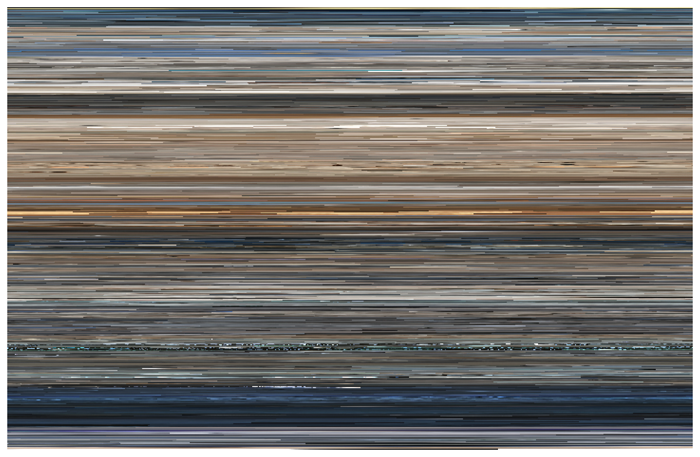
Parkinson told Wired that she reads the books looking for mentions of color and notes them on an Excel spreadsheet. Not surprisingly, Liz Stinson (Wired's reporter) has assumed an algorithm was involved. I was struck when Parkinson was quoted as saying "I find it absolutely irresistible to order them into a spectrum. It is kind of like when you have coloring pencils when you’re little, and they come in color order — they just look right." It made me think of another artist whose work I feel connected to - Jason Savalon - who has analysed the color scheme of films (yes, algorithms are involved...). His visualization of Titanic (below) struck me, when I first saw it, as perhaps the best way to see that movie.


Jason Savalon, The Top Grossing Film of All Time, 1 x 1    2000
Digital C-print mounted to Plexiglas.
Kidding aside, it revealed something to me about the movie, something about its structure. By reordering the references to color in the texts she selects, Parkinson gives us some sense of the proportion of the appearance of colors in the imagination of a book, but sacrifices the rhythm.

What I liked about Savalon's work was that it was constructed out of the act of reading and analyzing the film that it took as its subject. Its ultimate form was determined by its subject - and that is consonant with what I have tried to do when I consider writing in my work...

In 2011, I began to work with James McBride's memoir, The Color of Water. I was struck by how a book in which the role of color in establishing identity used reverence to color in the writing. I was also reminded of a news story I'd read about an oceanographer who was using the color seen in satellite images to determine the health of the seas. It seems to me necessary to cross these two ideas - that neither one would be sufficient.

I began reading McBride book for just its references to color and produced an edited version which consisted of only the names of hues


and translated that list of colors into Braille, substituting one dot for each pixel in a satellite photo of the sea. I wanted the resultin image to be large, overwhelming, so I printed it digitally and framed the 32 separate pages of the resulting image in narrow whote frames, that created a kind of window-pane through which one looked at the image...


Gerard Brown, The Color of Water (after James McBride), 2011, digital print on 32 sheets, 88 x 68 inches total
In the end, I wanted what I have wanted from these drawings since I started making them - something Parkinson touches on and Savalon delivers. I want to see the text anew through making images out of it, as a kind of active reading. I think Parkinson's work - as much as I like its crisp, graphic quality and appreciate her ingenuius take on a problem I have long thought about - doesn't excite me because it comes off as information, not as transformation. I learned when I set out translate a chapter of Moby Dick into drawings that, for me, it's not really enough to change the way information is looked at (as when Tauba Auerbach puts the Lord's Prayer - or the Bible -  in alphabetical order). That can be revealing, but it's somehow not enough of a gain.

The fundamental question that animates my work has long been, how much can something be changed without losing its identity? Is it still a text when it's translated into Braille? Sure. How about if that Braille is flat and large? Well, maybe. What if each of the six dots in the Braille letter is a different value, determined by another kind of text (a photograph) related to the first text? Now we're starting to cross a line from translation into transfiguration...

Thursday, September 12, 2013

The not-so fine print


I actually have gotten a little work done as I plow through grant applications. Yesterday, I printed a very large digital image on canvas. It looks good, and I'm thinking about what else I might do this way...

What was really exciting was the proofing process - I proofed on canvas but also on watercolor paper and that looked very cool. I have long wanted to do some prints of the color imagery I have made from translating Derek Jarman's Choma: A Book of Color into Braille. We'll see if those get into the work flow...

Grant season

I know that being a painter is not all making paintings, but the fewer days I spend trying to raise money to make work the better.

In fact, I chose painting as a way of making art because it afforded a lot of independence from institutional structures. You don't need expensive equipment like presses or kilns or computers...you really can do a lot with extremely basic materials.

But there are times when you want to do more, and getting outside support is essential, even if it means photographing work and trying to explain exactly what it is you're doing...

Photography is the hardest part for me. I was born in the era of slides and I still think of images of work as little objects that have to live someplace in the universe. I cannot keep straight my digital files of my work, and the fact that each application appears to have its own preferences for the format of images is utterly maddening. The last two days have been spent shooting and touching up images in Photoshop, and I still have very little confidence of them. At least one can touch up the images; in the age of slides, I could never get pictures that filled the frame or that were not skewed in some way. Thank heaven for the lens correct filter...

I can see that one way to make the photo task easier would be to have a space or a block of time set aside for it. As it is, I am always patching together lighting and wall space and things never seem to be where I need them. This is something I can fix, and hope to soon.

And while I've always found it very easy to write about others' work, writing about my own is a headache. I am always convinced that I am not really where I should be, that I don't have enough work, and that I'm not making it clear what I plan to do next. That could be because I am not a very strategic painter; I remain more interested in following ideas where they lead than in following a plan for getting from here to there in my work. Too much of my life as a teacher and administrator has become about identifying and achieving objectives; my studio should remain (as much as possible) a place where I can refrain from having clear objectives and see where things go.

I have also become terribly distrustful of the idea of progress in the studio - progress toward what? From what to what? When you adopt the idea that audiences make art out of the pictures you produce, you have to face the fact that you're not making art until it gets out of your control. I'm okay with that, but it seems like an idea that is tacitly disapproved of grant applications, which foster the illusion of self control and agency in artists...as if we were really driving the bus.

But I have at least three major funding proposals to get together this fall, and two exhibits to propose based on work that already exists. I have never really liked the idea of the artist who works so hard to get things out of the studio that he doesn't make work, but I don't like the idea of drowning in work or of not being able to carry out ideas because they require me to seek financial or technical help.

Update:
I had a small revelation as I went to mail the application today, after spending another three hours tinkering with it...I would never have been able to complete this grant application had I been teaching this semester. If I get this award, it will have a huge impact on what I can make in the next year. If not, well, at least I tried. It's disturbing to think about how much work doesn't get thought out because of the pressures of our day to day lives. I don't know that I'll be able to be so much more organized when I return to work from this sabbatical, but I will be aware of how much less creative work I - and all my colleagues - are getting done...

Tuesday, September 10, 2013

Artists - Opportunity for Exhibit Art in the Open 2014

Nancy Agati, 2013 ARt in the Open
A Call for Proposals has been posted for the 2014 Art in the Open in Philadelphia. I am delighted to be among the judges for this year's show, and hope artists engaged with site and landscape will consider applying. Here's the idea behind the exhibit:
AiO celebrates the Philadelphia landscape as both inspiration and as an open-air studio for artists. For three days each Spring, from Fairmount Water Works to Bartram's Garden, AiO will explore the natural beauty and urban character of the Schuylkill River: where West Philadelphia separates from Center City and thousands of people enjoy a beloved recreational park of paths and views.
You needn't be local to Philly to participate - please share this opportunity widely. I'm looking forward to some great ideas...