InLiquid.com regulary has get togethers for curators and directors at various watering holes in and around Philadlephia. I cannot make the next one, but it came with a line in the invitiaton encouraging us to "feel free to extend the invitation to anyone who might be appropriate"... And I think you're all appropriate.
Here's the details:
@ N. 3rd, Tuesday evening, February 28th from 6:30-8:30 pm (N. 3rd, incase you are not familiar, is located on the corner of 3rd and Brown in Northern Liberties.)
Enjoy!
Monday, February 27, 2006
Saturday, February 25, 2006
THE LAST FAVOUR
 You are cordially invited to a spirited reading from Teresa Jayne's new book, The Last Favour, "a primer for young men on how to woo a woman." The event will take place on Wed., March 1-5:30pm at the Rosenbach Museum and Library, 2008-2010 DeLancey Place in Philadelphia. For more details, call (215) 732-1600, ext. 113 or visit the Rosenbach online at http://www.rosenbach.org. RSVP'S are kindly requested. Jaynes' is a gifted artist who was invited to create this book after her last installation at the Rosenbach in 2000, titled, Red Room. The Last Favour was co-published by the Rosenbach and the Borowsky Center at the University of the Arts, with funding from the Leeway Foundation and the Elizabeth Firestone Graham Foundation.
Monday, February 20, 2006
Of Patronage

I wanted to shout a little shout for Rebecca Solnit's piece in this weekend's LA Times about the recent sale of Asher B. Durand's Kindred Spirits to Walmart heiress Alice Walton.
Solnit's suggestions that Walmart is trying to clean up its act by opening a museum of all the things it is not is a shrewd bit of linguist prestidigitation, but one wishes she's lingered longer on the history of robber barons cleansing their consciences through acts of public largess than on the preposterous notion that Walton might take an interest in "the art of her time". The fact remains that few have an interest in the "art of their time", especially among the patronage classes, who are inclined to even less interest when said art is critical of them and their business dealings.
Though I find the idea of a Walmart Biennial amusing, it would be foolish to insist it include only artists who protest Walmart’s policies and practices, in part because such a show would be a dreadful bore. As if providing any artist whose work amounts to propaganda - from the right or the left - would be a public service. Better to recognize the terrible complexity of the issue and look for artists who don't pretend to be above it. Perhaps, if they could be found, such artists might rekindle the public's interest in contemporary art, which they might (rightly) feel shares little with their own lives.
Then, we might really be kindred spirits again.
Friday, February 03, 2006
Fred Tomiselli Lecture @ The Fabric Workshop 2/3/06

Hi All, This post comes after the Fred Tomiselli lecture this evening. After a fried Bologna w/potato sandwich and two glasses of wine, I'm watching The Grizzley Man: with Timothy Treadwell, on the Discovery Channel. I think it has scared me to my bones! (I'm contemplating another glass/bottle!) That's another story. Since we Americans are all officially addicted to oil, I thought that I would relate an interesting project that Mr. Tomiselli offered. Tomiselli was talking about his process of collecting images. He showed pages of bird books with the images cut out. The images were haunting. They were perfectly liberated from their former rectangle with a surgeon's precision, like the empty silhouettes of Victorian shadow portraits. He mentioned the enormous amount of catalogues he received in the mail. He thought... Here we are, outside and observing nature, dressed in our petroleum based, weather managing wear! He made the most amazing collages of the birds wearing images of fleece and Gortex that he cut out of catalogues. The colors and textures mimic the actual colors of the creatures studied. More to come! Insightful and witty talk. (Agati, Doreen and I were not the "scruffy" art students he noticed in the audience!) Terri
Thursday, February 02, 2006
NCECA
Just a quick question. Is anyone thinking about going to the Clay conference in Portland Oregan? Jamin London has offered a free place to stay (her house) and so far Tammi and myself have thought about going. I'm pretty sure as UARTS students we get a student discount so the registration is about $155.00. If anyone works in clay and has the time to take off in the middle of March then I'd take the oppurtunity to go.
Tuesday, January 31, 2006
Artists? We don't need no stinkin' artists!

Anyone else see Holland Carter's piece from today's New York Times about David Hammons: The Unauthorized Retrospective at Harlem's Triple Candie gallery? Excuse me as I muddle through my complex feelings on the subject.
For those who missed it (or are too busy to click through the links) the gallery has long been interested in doing a show with the artist David Hammons, who has, for one reason or another, long not been doing a show with the gallery (collectors of major pieces were also unwilling to lend their holdings, Cotter reports). So, to make a long story short, the gallery Xeroxed and printed from its computers nearly 100 images of Hammons' pieces and taped them to the wall, and voila, instant retrospective. Call it the Kitty Kelly school of curating, but it sounds brilliant. (an image of the installation from their website appears above). A passage from Triple Candies' website notes that
On one level, the exhibition is about David Hammons' art and career. On another, it is about the art world: particularly how the strategic process of ascribing value to an artist's - by galleries, collectors, and even artists - changes the art's relationship to the public. Finally, this collection of reproductions is meant to question the status-quo of exhibition-making itself.
As a teacher, I've asked artists to simulate exhibitions in which they locate their work in the context of other artists with whom they wish to be associated using architectural models and PowerPoint presentations. Asking artists to behave like curators has - for a long time to me - been like asking workers to behave like management for a day. These purely theoretical exhibit projects have expended and attracted only intellectual capital, not the cold hard cash that dealers and institutions use to accomplish their missions, and have demanded from their audience - mostly other students - only the outlay of a few minutes of thought.
But as a curator, I’ve always felt like it’s my job to bring the real deal to audiences. If I cannot obtain the piece I want for a show, I have to reconsider the show (it has always struck me as being like editing a book; if I cannot get a brilliant essay by someone on a certain topic, I can’t take another one they had lying around as a replacement).
Part of me feels like Triple Candie is doing something (through its simulation) that many of us have been engaged in all along. Part of me now realizes the ethical complexity of what we’ve been engaged in all along through simulation. In a world in which the art object is increasingly irrelevant in the first place (see Sunday’s LA Times article on the use of modern architecture as a means of increasing snob appeal for shampoo and car ads…) art images reign supreme. If we want to participate in our culutre in the way it wants or expects us to participate, artists should be making images limited to the palette of web browsers, scalable for printers, and sufficiently graphic for production at any size. We should be ready for whatever we make to be repurposed and incorporated into others' work and products. We should recognize that we are in the raw materials business.
Monday, January 30, 2006
Careers Panel
Hello again everyone!
So I was invited to do a careers panel for the University of Mary Washington. The panel was tonight, Monday the 30th at 4:00 pm in one of my old art history lecture halls. The panel consisted of me (2003 graduate)and three other girls who had graduated in 2004. Basically the panel is put on once a year for students in the art and art history department at UMW. The panel always consists of graduated students from UMW who have found work with thier BA in studio art degrees. Of course, I was asked to come back because the amount of students interested in graduate school, so they thought i'd be able to talk a little bit about how I got into the UARTS program and all the troubles I had getting into graduate school in the first place.
The panel was great! I'd say about twenty students showed up and we talked for about an hour and fourty five minutes. One presenter was a highschool art teacher, one was the productions coordinator for George Washington University and the other was a gallery manager for a gallery in Richmond VA.
It was great to talk with everyone because we all went in such diverse directions with our degrees. It turns out that all the presenters have been considering going back to school to get their MFA's.
I guess why I'm writing this all to you in the first place was that having to explain to the soon-to-be graduates of UMW about the difficulties getting into an art graduate program in the first place, and then explaining a little bit about my work and the work ethic I had to develop, I guess it all energized me a bit to work even harder this semester. Because the truth is that I tried for two years to get into a grad program, and now that I have, I'm sure as hell not going to waste it.
So I was invited to do a careers panel for the University of Mary Washington. The panel was tonight, Monday the 30th at 4:00 pm in one of my old art history lecture halls. The panel consisted of me (2003 graduate)and three other girls who had graduated in 2004. Basically the panel is put on once a year for students in the art and art history department at UMW. The panel always consists of graduated students from UMW who have found work with thier BA in studio art degrees. Of course, I was asked to come back because the amount of students interested in graduate school, so they thought i'd be able to talk a little bit about how I got into the UARTS program and all the troubles I had getting into graduate school in the first place.
The panel was great! I'd say about twenty students showed up and we talked for about an hour and fourty five minutes. One presenter was a highschool art teacher, one was the productions coordinator for George Washington University and the other was a gallery manager for a gallery in Richmond VA.
It was great to talk with everyone because we all went in such diverse directions with our degrees. It turns out that all the presenters have been considering going back to school to get their MFA's.
I guess why I'm writing this all to you in the first place was that having to explain to the soon-to-be graduates of UMW about the difficulties getting into an art graduate program in the first place, and then explaining a little bit about my work and the work ethic I had to develop, I guess it all energized me a bit to work even harder this semester. Because the truth is that I tried for two years to get into a grad program, and now that I have, I'm sure as hell not going to waste it.
Sunday, January 29, 2006
Spring bookshelf
As promised, here is a list of what people have said they'll be reading and reearching this semester. Please take it upon yourself to recommend readings to one another if you can think of anything.
Paul DeMarco Will be writing his paper as a mock submission to an academic conference. An abstract will be available in late February.
Keith Gruber intends "to explore two, integral topics that I will be pursuing in the studio; the Seven Virtues (supplemented with the Seven Sins), and the use/ meaning of the white spaces used in my paintings." On his list are the following texts:
Chris Houston wants to "begin an investigation of work by painters and literary artists who present imagery portraying a sense of desolation and social (human) separation, perhaps even despair." In my responses to his proposal, I've sent some specific texts, but I would encourage you to offer your thoughts as well, either in the comments here or by emailing him directly.
Vanessa Juriga "plan[s] to focus on extremely specific points during the spring 2006 semester: Abstract Expressionism, Chinese Calligraphy and landscapes, Sumi-e, and word art." She'll be using:
Tim Murphy will be looking at the art of children and other primates. He will be reading:
Aubrey Navarro plans to do research into a topic of importance to her studio work: folly. She sent a list of titles she'll be looing into:
Mike Reenock is addressing the theme of "representation of the self in narrative" and will be producing a single long paper this semester. Its bibliography will evolve as it is written.
Terri Saulin will be addressing the importance of complexity contemporary art, partly inspired by the Swarm show at the fabric Workshop and Museum. She'll be reading:
Maleese Schick will be writing numerous short papers about her studio work and issues concerning her faith, beginning by revisiting Eve's role in the Fall of Man. Her readings include:
Deb Yarrington moves from fairy tales to myth this term. She'll be reading:
Paul DeMarco Will be writing his paper as a mock submission to an academic conference. An abstract will be available in late February.
Keith Gruber intends "to explore two, integral topics that I will be pursuing in the studio; the Seven Virtues (supplemented with the Seven Sins), and the use/ meaning of the white spaces used in my paintings." On his list are the following texts:
• Batchlor, David. Chromophobia. London. Reaktion Books Ltd: 2000.
• de Goya, Francisco. Los Caprichos. Toronto. Dover Inc: 1969.
• Manguel, Alberto. Reading Pictures: A History of Love and Hate. New York. Random House: 2001.
Chris Houston wants to "begin an investigation of work by painters and literary artists who present imagery portraying a sense of desolation and social (human) separation, perhaps even despair." In my responses to his proposal, I've sent some specific texts, but I would encourage you to offer your thoughts as well, either in the comments here or by emailing him directly.
Vanessa Juriga "plan[s] to focus on extremely specific points during the spring 2006 semester: Abstract Expressionism, Chinese Calligraphy and landscapes, Sumi-e, and word art." She'll be using:
• Clarke, David. Images of Asia: Modern Chinese Art. Oxford University Press. 2000.
• Gaugh, Harry F. The Vital Gesture: Franz Kline. Cross River Press, Ltd. 1085.
• Sato, Shozo. The Art of Sumi-e: Appreciation, Techniques, and Application. Kodansha International Ltd. 1984.
• Silbergeld, Jerome. Mind Landscapes: The Paintings of C.C. Wang. University of Washington Press. 1987.
Tim Murphy will be looking at the art of children and other primates. He will be reading:
• Chaminade, T., Meltzoff, A. N., & Decety, J. “Does the end justify the means? A PET exploration
of the mechanisms involved in human imitation.” NeuroImage, 15, (2002)
• Decety, J., Chaminade, T., Gre`zes, J., & Meltzoff, A. N. “A PET exploration of the neural
mechanisms involved in reciprocal imitation.” NeuroImage, 15, (2002)
• Galef, B.G., Jr., “The question of animal culture.” Human Nature, 3 (1992)
• Morris, Desmond, The Biology of Art: A study of the Picture-Making Behavior of the Great Apes
and Its Relationship to Human Art (New York: Knopf, 1962)
• Shiller, Paul H., “Figural Preferences in the Drawings of a Chimpanzee,” Journal of Comparative
and Physiological Psychology No. 44 (1951)
• Whiten, A., Custance, D. M., Gomez, J. C., Texidor, P., & Bard, K. A.. “Imitative learning of
artificial fruit processing in children (Homo sapiens) and chimpanzees (Pan
troglodytes).” Journal of Comparative Psychology No. ?? (1996)
Aubrey Navarro plans to do research into a topic of importance to her studio work: folly. She sent a list of titles she'll be looing into:
• Firchow, P. “H. G. Wells's "Time Machine": In Search of Time Future--and Time Past”. The Midwest Quarterly v. 45 no. 2 (Winter 2004) p. 123-36
• Tournier, M. “Jules Verne and Around the World in Eighty Days”. World Literature Today v. 76 no. 2 (Spring 2002) p. 107-8
• Gibbs-Smith, Charles Harvard. The Invention of the aeroplane, 1799-1909. New York, Taplinger, 1966
• Van Dulken, Stephen. Inventing the 19th century : 100 inventions that shaped the Victorian Age from aspirin to the Zeppelin. New York : New York University Press, 2001
• Van Dulken, Stephen. Inventing the 20th century : 100 inventions that shaped the world from the airplane to the zipper. New York : New York University Press, 2002
Mike Reenock is addressing the theme of "representation of the self in narrative" and will be producing a single long paper this semester. Its bibliography will evolve as it is written.
Terri Saulin will be addressing the importance of complexity contemporary art, partly inspired by the Swarm show at the fabric Workshop and Museum. She'll be reading:
• Batchelor, David, Chromophobia. Reaktion Books Ltd., London, 2000, 2002 & 2005.
• Beckley, Bill, David Shapiro, Ed. Uncontrollable Beauty. Allworth Press, NY, NY, 1998.
• Danto, Arthur C., After the End of Art: Contemporary Art and the Pale of History. Princeton University Press, Princeton, NJ, 1997.
• Danto, Arthur C., The Abuse of Beauty: Aesthetics and the Concept of Art. Open Court / Carus Publishing, Chicago and La Salle Ill., 2003.
• Del Vecchio, Mark, Garth Clark, Postmodern Ceramics. Thames and Hudson, NY, NY 2001.
Elkins, James, The Object Stares Back: On the Nature of Seeing. A Harvest Edition, Harcourt, Inc., San Diego, NY & London, 1996.
• Hickey, Dave, Air Guitar: Essays on Art and Democracy. Art Issues. Press, Los Angeles, CA, 1997.
• Hickey, Dave, The Invisible Dragon: Four Essays on Beauty. Art Issues. Press, Los Angeles, CA, 1993, 5th impression, 1999.
• Johnson, Steven, Emergence: The connected lives of ants, brains cities and software. Scribner, NY, NY, 2001.
• Miller, Abbott, Ellen Lupton, Swarm. The Fabric Workshop and Museum, Phila. PA, 2005.
• Waldrop, M. Mitchell, Complexity: The emerging science at the edge of order and chaos. A Touchstone Book, Simon &Schuster, NY, London, Toronto & Sydney, 1992.
• Wolfram, Stephen, A New Kind of Science. Wolfram Media, Inc., Champaign, Il., 2002.
Maleese Schick will be writing numerous short papers about her studio work and issues concerning her faith, beginning by revisiting Eve's role in the Fall of Man. Her readings include:
• Adler, Rachel.Engendering Judaism : An Inclusive Theology and Ethics.Boston: Beacon Press 1999.
• Baskin, Judith. Midrashic Women: Formations of the Feminine in Rabbinic Literature. Hanover and London: Bradeis University Press, 199?
• Biale, Rachel. Women and Jewish Law : The Essential Texts, Their History, and Their Relevance for Today New York: Shocken Books inc, 1984
• Cox, Meg, The Heart of Family: Searchung America for New Traditions That Fulfill Us.New York: Random House, 1998.
• Plaskow, Judith,The Coming of Lilith : Essays on Feminism, Judaism, and Sexual Ethics, 1972-2003. Boston, 2005.
• Plaskow, Judith, Standing Again at Sinai: Judaism from a Feminst Perspective. San Francisco, 1991.
• Ochs Vanessa, Sarah Laughed, Modern lessons from thee wisdom and stories of biblical women. New York: Mc Graw Hill, 2005
Deb Yarrington moves from fairy tales to myth this term. She'll be reading:
• Tony Cragg: Signs of LifeWenzel Jacob
• Michael Lucero: Sculpture 1976-199Mark Richard Leach
• Danville Chadbourne (Ceramics Monthly article by Jim LavillaHavelin)
• Son of a Witch Gregory Maguire
• Mirror Mirror Gregory Maguire
• The Power of Myth Joseph Campbell
• The Hero with a Thousand Faces Joseph Campbell
Wednesday, January 25, 2006
Hoodwinked
Hello all! Looking Forward to a productive semester! I've decided that one of my goals for this semester is to write on the blog at least once or twice a week. I have a ton of reading on Myth and I just added seven more books on the figure in clay. I just figured if I write a little bit about all the reading and research that I was doing this semester it would not only be a helpful synopsis for me but it might start some great conversations with anyone else who might be heading in similar directions.
So I decided to see the new animated movie "Hoodwinked". I don't know how many of you are into animated movies, but if you haven't guessed it yet, I'm kind of a kid at heart when it comes to animation. Truth be told, I own way to many animated films....and yes...I watch them all...Over and over again....I know all the words...
Anywho, "Hoodwinked" was a cute story. Basically the writer decided to take the tale of Little Red Riding Hood and twist it up a bit. This reminded me greatly of how Gregory Maguire has turned the story of the Wizard of Oz around with his books "Wicked" and "Son of a Witch". The gist is, Little Red, Granny, the Wolf, and the Woodcutter are all caught up in this scandal going on the woods. It seems that somebody has been going around the forest stealing "goody" recipes from all the local sweet stores. It just so happens that Granny heads up the most successful goody industry in all the land, which makes her a prime suspect. The movie picks up where the story leaves off. All the characters converge in Granny's house and that's when the backstories come into play.
You get to see the story from the perspectives of each character as they live their lives and eventually meet up on that fateful day at Granny's house. You see Red as a delivery girl working for her Granny who wishes to get out of the family business. You see the Wolf as a reporter just trying to get the story of the goody thief published and solved. You see Granny as the daredevil, thrill-seeker, who gets caught up in the scandal and finally the Woodsman as an out-of-work actor just trying to "be the part" of a woodsman.
There are a slew of other cute and sarcastic characters that add to the story. I have to say that the sarcasm and wit is non-stop, but its a tame enough movie to bring your kids to. I think if I were to retell a fairy tale, or in that case, if anyone in today's society, witht the sarcasm, wit and humor that tends to run ramped today were to retell a fairy tale, this might be the outcome.
Yes, there is still that happy ending, because it wouldn't be a fairy tale if there wasn't one. Do the characters learn their lessons? Yes, and family members are brought closer together. Is there magic and enchantment involved? Yes, I'm sure I'm not the only one who as a kid thought about jumping off of something with a cape or an umbrella just to see if it truly would make me fly. So I think "Hoodwinked" does its job as a fairy tale and puts a nice spin on an old classic.
Lets face it, Little Red Riding Hood has had a shady past with a lot of sexual innuendo and explicit language. This is a fresh 21st century child-like spin, but with plenty of adult irony and wit to keep any audience interested and entertained. SO, if any of you got an hour and a half, go see it! Its a nice way to spend an evening!
So I decided to see the new animated movie "Hoodwinked". I don't know how many of you are into animated movies, but if you haven't guessed it yet, I'm kind of a kid at heart when it comes to animation. Truth be told, I own way to many animated films....and yes...I watch them all...Over and over again....I know all the words...
Anywho, "Hoodwinked" was a cute story. Basically the writer decided to take the tale of Little Red Riding Hood and twist it up a bit. This reminded me greatly of how Gregory Maguire has turned the story of the Wizard of Oz around with his books "Wicked" and "Son of a Witch". The gist is, Little Red, Granny, the Wolf, and the Woodcutter are all caught up in this scandal going on the woods. It seems that somebody has been going around the forest stealing "goody" recipes from all the local sweet stores. It just so happens that Granny heads up the most successful goody industry in all the land, which makes her a prime suspect. The movie picks up where the story leaves off. All the characters converge in Granny's house and that's when the backstories come into play.
You get to see the story from the perspectives of each character as they live their lives and eventually meet up on that fateful day at Granny's house. You see Red as a delivery girl working for her Granny who wishes to get out of the family business. You see the Wolf as a reporter just trying to get the story of the goody thief published and solved. You see Granny as the daredevil, thrill-seeker, who gets caught up in the scandal and finally the Woodsman as an out-of-work actor just trying to "be the part" of a woodsman.
There are a slew of other cute and sarcastic characters that add to the story. I have to say that the sarcasm and wit is non-stop, but its a tame enough movie to bring your kids to. I think if I were to retell a fairy tale, or in that case, if anyone in today's society, witht the sarcasm, wit and humor that tends to run ramped today were to retell a fairy tale, this might be the outcome.
Yes, there is still that happy ending, because it wouldn't be a fairy tale if there wasn't one. Do the characters learn their lessons? Yes, and family members are brought closer together. Is there magic and enchantment involved? Yes, I'm sure I'm not the only one who as a kid thought about jumping off of something with a cape or an umbrella just to see if it truly would make me fly. So I think "Hoodwinked" does its job as a fairy tale and puts a nice spin on an old classic.
Lets face it, Little Red Riding Hood has had a shady past with a lot of sexual innuendo and explicit language. This is a fresh 21st century child-like spin, but with plenty of adult irony and wit to keep any audience interested and entertained. SO, if any of you got an hour and a half, go see it! Its a nice way to spend an evening!
Tuesday, January 24, 2006
Writing Deadlines
A gentle reminder that I am trying to deal with the chaos of last semester by having deadlines this spring. I've cribbed them from Tom and Pat, so please arrange to send writing at the appointed times.
Tuesday, January 17 - Class starts - Email or send instructor study plan by January 20th.
Friday, February 3 - End of week 3 - Email update to instructor summarizing first three weeks of research, plus any corrections to study plan.
Friday, February 17 - End of week 5 - First paper due.
Friday, March 3 - End of week 7 - Email update to instructor.
Week of March 6 - Spring Break - Blog Storm
Friday, March 31 - End of week 10 - Second paper due.
Friday, April 14 - End of week 12 - Progress report on third paper.
Friday, May 6 - End of week 15 - Third paper due. Participants will present papers at a class to be held at the beginning of the summer session.
Tuesday, January 17 - Class starts - Email or send instructor study plan by January 20th.
Friday, February 3 - End of week 3 - Email update to instructor summarizing first three weeks of research, plus any corrections to study plan.
Friday, February 17 - End of week 5 - First paper due.
Friday, March 3 - End of week 7 - Email update to instructor.
Week of March 6 - Spring Break - Blog Storm
Friday, March 31 - End of week 10 - Second paper due.
Friday, April 14 - End of week 12 - Progress report on third paper.
Friday, May 6 - End of week 15 - Third paper due. Participants will present papers at a class to be held at the beginning of the summer session.
Tuesday, January 17, 2006
Spring Proposal Highlight
Just thought I would pass along a summary of what I plan to be painting/ researching this spring, it is going to be big step for me, both in size/ quantity and meaning. I reckon I can pull it off, I'm just going to have to paint like my hair's on fire. Any and all feedback is welcome, good luck to all with the spring semester, Keith.
"For the spring semester I hope to execute seven life-sized, portraits of teenagers residing in the dorm where I live/ work. I would like to base these paintings on either the Seven Sins or the Seven Virtues, depending on the findings from my preliminary research. These portraits will be painted in the same manner as my recent portraits, using oil on gauche, and placing the figure on a stark white background. Ultimately I will be treating these seven portraits as one work, and devising a composition that establishes a narrative between the painted figures as well as the viewer."
"For the spring semester I hope to execute seven life-sized, portraits of teenagers residing in the dorm where I live/ work. I would like to base these paintings on either the Seven Sins or the Seven Virtues, depending on the findings from my preliminary research. These portraits will be painted in the same manner as my recent portraits, using oil on gauche, and placing the figure on a stark white background. Ultimately I will be treating these seven portraits as one work, and devising a composition that establishes a narrative between the painted figures as well as the viewer."
Saturday, January 07, 2006
So where is this painting hanging?
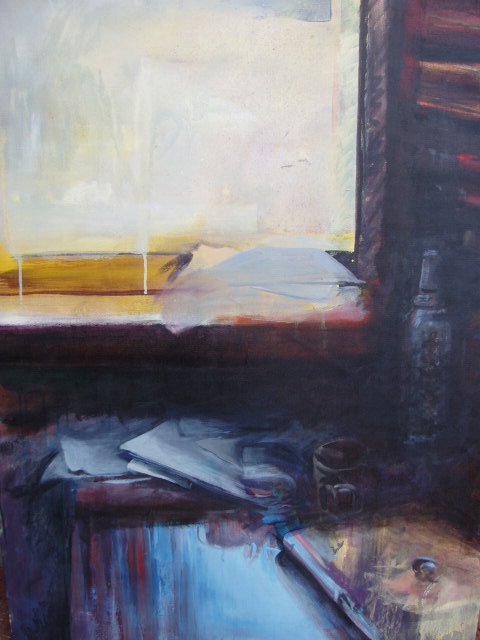 " My Desktop" by yours truly. 2005, Acrylic on Canvas, 36"x 49.5"
Finished or unfinished the bottles are starting to disappear (does he mean the bottles at home or in the painting?), and my direction is in doubt. Is this painting begining to be about light, space, color, atmosphere, social commentary, or something completely different? I invite your comments, opinions, and frank criticism. I'm seeking influence. -C.
Saturday, December 31, 2005
Kathy Butterly
 KATHY BUTTERLY: Slide lecture and dinner! Friday, February 10, 2006. This sought after ceramic artist and Moore College of Art and Design / UC Davis graduate, will lecture at 6:30pm at the University of Pennsylvania Chemistry Building, 231 S. 34th Street in Philadelphia. The event will be followed by dinner in a private area residence at 8pm. For more info and ticket information contact Christina Edleman at The Clay Studio, 215-925-3453 x13 or go to www.theclaystudio.org. Seating for both events is limited.
Wednesday, December 28, 2005
Where is your art supposed to go, anyway?
Is it really a surprise to anyone that museums exhibit less than 5% of the work they collect?
The Los Angeles Times would have us believe that this is, in fact, news. And while artists are shocked (...shocked!) to find there's no room in the museum for their work, museums remain the gold standard for achievement in our profession. What is wrong with this picture?
I've been having this sidebar conversation via email with an artist who's getting his MFA and is thinking about his thesis show and how it seems like an artificial thing. While everyone asks him if he's showing, his frustration about the need to exhibit while he's still growing as an artist has been simmering. To him, rolling out a bunch of canvases and standing there delivering the artspeak to his teachers and invited guests isn't going to transform him into the artist he wants to be. To him, showing these paintings is a step on a path that is supposed to last a lifetime. When I was in school, we used to say we were learning to paint so we could be great artists in our 60s. That's what I read between the lines of this artist’s emails.
Of course, at the time we were all saying this, others were snickering that we were only saying it because there was no room in the Whitney Biennial for us and that this was some sort of sour-grapes strategy. But really. With nearly 10,000 new artists getting degrees every year, where the hell are all these paintings, sculptures, installations, ceramics, prints, books, and whatever supposed to go?
I recall preparing for my thesis exhibition and working on these paintings that I wanted to have a certain pearly finish. One of the people who came to my studio, perhaps in an effort to get me to lighten up, told me that she regarded student work as proposals for mature work. Maquettes, essentially, for work we’d be really do when we got out of school. I did lighten up and get the paintings done, but I’ve been haunted by this feeling for a few years, that most art I look at is really a discursive foray, not an object made to any kind of exacting specifications.
One of the most interesting books I’ve looked at recently is Deep Storage: Storing, Collecting Archiving in Contemporary Art, edited by Ingrid Schaffner and Matthais Winzen. It’s a kind of index of an exhibition and a practice artists (and – whoa- non-artists, too) are deeply engaged with in society (Google “scrapbooking” if you don’t believe me). In a weird way, it reminded me of an equally fascinating but less hip book, David Halle’s Inside Culture: Art and Class in the American Home. Halle’s writing is not exactly memorable, but the book is illustrated with dozens of images of the interiors of people’s houses and the art that hangs in such spaces. It’s a little like a hardcore version of Dwell or Met Home except that unlike these sterilized decorator magazines, one sees how lives are rearranged to accommodate paintings and sculpture and how these things – removed from their white cubes and glossy art magazines – might really affect people who live with them.
Maybe this is just another way of getting at the problem of gross overproduction in studio art. Consider the thing you’re making in its life outside of the studio, the gallery, the museum, or the magazine. Consider making things that cannot be photographed so you don’t place more value on the slide or digital image than on the thing you’re making. Consider that the art most of us love, doesn’t come with an artist who stands beside it and drones on in artspeak.
The Los Angeles Times would have us believe that this is, in fact, news. And while artists are shocked (...shocked!) to find there's no room in the museum for their work, museums remain the gold standard for achievement in our profession. What is wrong with this picture?
I've been having this sidebar conversation via email with an artist who's getting his MFA and is thinking about his thesis show and how it seems like an artificial thing. While everyone asks him if he's showing, his frustration about the need to exhibit while he's still growing as an artist has been simmering. To him, rolling out a bunch of canvases and standing there delivering the artspeak to his teachers and invited guests isn't going to transform him into the artist he wants to be. To him, showing these paintings is a step on a path that is supposed to last a lifetime. When I was in school, we used to say we were learning to paint so we could be great artists in our 60s. That's what I read between the lines of this artist’s emails.
Of course, at the time we were all saying this, others were snickering that we were only saying it because there was no room in the Whitney Biennial for us and that this was some sort of sour-grapes strategy. But really. With nearly 10,000 new artists getting degrees every year, where the hell are all these paintings, sculptures, installations, ceramics, prints, books, and whatever supposed to go?
I recall preparing for my thesis exhibition and working on these paintings that I wanted to have a certain pearly finish. One of the people who came to my studio, perhaps in an effort to get me to lighten up, told me that she regarded student work as proposals for mature work. Maquettes, essentially, for work we’d be really do when we got out of school. I did lighten up and get the paintings done, but I’ve been haunted by this feeling for a few years, that most art I look at is really a discursive foray, not an object made to any kind of exacting specifications.
One of the most interesting books I’ve looked at recently is Deep Storage: Storing, Collecting Archiving in Contemporary Art, edited by Ingrid Schaffner and Matthais Winzen. It’s a kind of index of an exhibition and a practice artists (and – whoa- non-artists, too) are deeply engaged with in society (Google “scrapbooking” if you don’t believe me). In a weird way, it reminded me of an equally fascinating but less hip book, David Halle’s Inside Culture: Art and Class in the American Home. Halle’s writing is not exactly memorable, but the book is illustrated with dozens of images of the interiors of people’s houses and the art that hangs in such spaces. It’s a little like a hardcore version of Dwell or Met Home except that unlike these sterilized decorator magazines, one sees how lives are rearranged to accommodate paintings and sculpture and how these things – removed from their white cubes and glossy art magazines – might really affect people who live with them.
Maybe this is just another way of getting at the problem of gross overproduction in studio art. Consider the thing you’re making in its life outside of the studio, the gallery, the museum, or the magazine. Consider making things that cannot be photographed so you don’t place more value on the slide or digital image than on the thing you’re making. Consider that the art most of us love, doesn’t come with an artist who stands beside it and drones on in artspeak.
Thursday, December 22, 2005
Out of Body
Perhaps it began with Dave Hickey's successful attempt to make beauty an "issue", but it seems that the thing underlying most contemporary exhibitions now is a desire on the part of curators to present art as overwhelming, even ravishing, to the viewer. The beauty debate returned sensualism to the table, giving it some long-overdue new vocabulary.
As a result, it's not enough now to look at work or think about it, one must be staggered by it. Consider the complexity-theme in the Fabric Workshop's "Swarm" exhibit. It exists to create the impression that art is just too much to understand intellectually, that at some point, the information passing through your eyes will be too much for your brain, that overload is inevitable and your flight instinct ought to be kicking in soon lest you face a dangerous neurological episode brought on by too much looking.
This ideas followed me to Ecstasy: In and About Altered States at the LA MoCA. The show is at times like a flashback to early teenage parties – complete with the boredom of watching stoned people fascinated by themselves. Matt Mullican’s entranced video, in which the artist plays with pens, rolls of tape and trash cans in a hypnotized state - is a chore, and Paul Sietsema’s Untitled (Beautiful Place) is nineteen minutes of starting at a houseplant. That’s more than I could do even under the influence of some passport to an Altered State.
But thankfully, there’s more to the show than ruminations on drug culture, though these references are abundant (more on that in a minute). One of the exhibit’s announced agendas is to “simulate or induce” metaphysical states in the viewer. Here is where the show’s most successful works can be found. Olafur Eiasson’s Your strange certainty still kept (1996) employs economical means to extraordinary ends. In a darkened room, four strobe lights pulse and appear to freeze tiny droplets of water in midair. As you and other viewers walk around the room at normal speed, the droplets hover and hop around as if they’re in another part of the time/space continuum.
Erwin Redl’s Matrix II is similarly low-tech (which matters in a town where special effects are a big deal). Hundreds of tiny green LEDs hang in straight lines from the ceiling, creating rows of pale blips that call to mind the torrents of computer code in the Wachowski bothers’ movies. The piece, which at first seemed underwhelming, is saved by its enormity. At first, it’s hard to believe one isn’t looking at house-of-mirrors trick, but when you walk into the illuminated field and see the various tricks simple geometry can play, it’s hard not to be stunned into a pleasurable numbness.
The show also includes strong works by Pipilotti Rist (whose video installation of dreamy projections and ethereal music suggests a ride at some future conglomerate of Disney and MTV) and Eija-Liisa Ahtila (whose multi channel video, Talo/The House gives one hope that artists might in fact be able to produce compelling cinematic works). And of course there are some pleasant standbys as well, like Tom Friedman’s Play-Doh placebos Sylvie Fleury's glam space orb, 8.
But too often the show is a parody of itself. I overheard people walking the galleries peeking into rooms and asking one another, “have we done this room yet?” At one point, a visitor asked the guard about the work upstairs. “Is there anything worth seeing up there?” One can’t fault a show for the visitors it attracts, God knows museums should be happy enough to see anything with a pulse walk in the door these days. But exhibitions can be faulted for the way arrange art works and create experience. To that end, one wants to laugh at Peter Huyghe’s L’expedition scintillant: a musical Acte 2: Lightbox in which tiny curls of smoke drift toward miniature theater lights, suggesting fantastic images. It’s not the object that is so ridiculous, but the artist’s use of music by Eric Satie and the arrangement of work itself, which suggests nothing so much as a banal 1970s living room where hip parents aspire to aesthetic transcendence while their children are upstairs raiding the medicine cabinet.
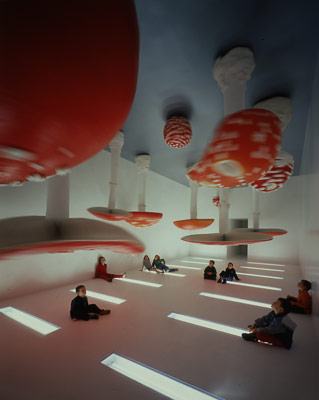
The whole drug thing goes horribly overboard with the repetitious mushroom imagery. Come now. Do were really need three different artists mushroom images? One looks to curators for choices – select the best image for the show. Shrooms from Roxy Paine and Takashi Murakami and Carsten Holler (whose Upside-Down Mushroom Room is in the picture above, by the way) make it look like you’re covering your bases, not like we’re getting insight into nuances of a subject.
On the whole, Ecstasy’s greatest strength is its articulation of visual experiences so exciting they defy judgment. When looking at the best works in the show, it simply seems irrelevant to ask about their importance as art; they’re too busy delivering a charge. Those pieces that “simulate or induce” perceptual phenomena from sci-fi to schizophrenia are magical in ways that conventional representation cannot be. Painting suffers horribly in Ecstasy. It’s too abstract, too pictorial
Perhaps all this is a reflection of ongoing tensions over the split between the mind and the body. Perhaps it's a feverish attempt to relocate the mind inside the body, to make art less intellectually forceful and more, well, forceful. I’m not sure I think it’s a good thing for art to enter a realm where criticism is irrelevant, but it makes for a good trip.
Wednesday, December 14, 2005
Turn it up.

Maybe it's just that seeing MFA shows puts me in a frame of mind that seeks underlying aesthetics that could unify disparate artists, but I was amused to read Jerry Saltz Village Voice reviews of Mike Kelly and Jon Kessler's exhibits. Like a scientist diagnosing a new strain of art virus, Saltz whizzes through a flurry of names for the syndrome he’s trying to articulate – “the New Cacophony or the Old Cacophony, Agglomerationism, Disorientationism, the Anti Dia, or just a raging bile duct” – before asserting that “terms that describe this sculptural strategy include grandiose and testosterone-driven.” (italics original)
Hmmm. "Testosterone-driven?" I wonder what Erin, whose thesis installation was conceptually and structurally a whirlwind would say about that (and I'll invite her to respond). I wonder what Vanessa, who expressed such keen interest in the Swarm Exhibit at the Fabric Workshop and Museum would say. Or Terri, whose work may not manifest clutter in the way Kessler or Kelley do, but who pours references from the body to Beslan into her work. Or anyone who is a little curious about the ease with which such approaches are regarded as "strategic" rather than "tactical" or even in non-oppositional terms all together. But let's save that for another posting.
Before asserting that the "new cacophony" is "very gendered and very male", Saltz did offer one interesting read of the shows, which went like this:
Nowadays this all-at-once gambit can be seen as a way to compete with the paranoia and havoc of everyday life; a homeopathic dose of poison whereby ruins are created to counteract ruin; a manic-depressive panic attack in the face of information overload; a rejoinder to minimalism; a way to fill space and get attention.
Which put me in the mind of the Ellen Harvey show I was able to run in and see while in Philly. If you've not seen it yet, get off yer' ass and go(there's tiny picture above. It's tiny to frustrate you into going to see the real deal...). The four large mirrors are, on their own, enchanting enough to hold the space without the video elements of the show. But this notion that the image of a ruin of the Academy within its walls might constitute some form of inoculation rather than assault (Alex Baker's essay on the show was stunningly confrontational, wasn't it?) is an engaging notion, and perhaps one that deserves more thorough and consideration than the latest incarnation of bad-boy art.
Monday, December 12, 2005
Arts Journal Dance Forum
I know, I know. You hardly have time to read about art let alone dance, but I wanted to point out the ArtsJournal.com on-line debate on the state of dance as a model for our spring BlogStorm. Give it a look to get the idea, and be in touch.


Saturday, December 10, 2005
The Coming Storm
I want to thank everyone for the fascinating and skillful presentations in yesterday's all-too-brief meeting of the Writing Projects and Thesis Prep class. In several cases, talking about your research gave me insights into how it might be made more focused and useful for your studio - I hope it was helpful for you all to cap off the term by talking about the work you'd done and to hear about the impressive variety of work done by your peers.
Plans are afoot for the spring - I will distribute a revised syllabus by e-mail but I wanted to alert you to some significant changes:
Deadlines: It became almost unmanageably confusing for me to have writing coming in from all directions at anytime in the term. In order to budget time to properly respond to your papers, I'm going to set three target dates for you to pass in writing to me. You may continue to explore numerous short pieces (as Keith did) or develop longer works (like Mike or Paul), but I will respond to everything I get in relation to the target dates. It's important that I get writing at each target, because they will be tied to the dates I need to issue deficiency notices or take other administrative actions.
BlogStorm: I'm going to try something this spring. In lieu of writing one major paper, students may participate in a week-long BlogStorm I'm cooking up. I alluded to this in class yesterday and details will be forthcoming, but the gist of the idea is that everyday for a week invited guests will contribute blog postings on ideas that have been found in several students' writing to that point; you must provide three comments (totaling about 750 words) in the week to be excused from one of the papers. I think this will help restore some of the sense of information sharing that is missing from this remote and nomadic course, and hopefully it will put you in touch with a few new resources.
Bibliographies: I'm going to be revisiting the way the bibliography is incorporated into the proposals you submit at the beginning of the semester. I can't unilaterally abolish them, but I want them to be more evolutionary than summary documents (in other words, I want to change the idea that the class is about retrieving information and reporting it in a linear fashion and introduce the idea that this process is more of a loop; information begets expression, which instigates a search for new information that needs to be processed, summarized and expressed, leading to new inquiry). What we're after in the big picture is a more sustainable practice in the studio, and I think we can model that a little hear. I will therefore be asking you to look at the bibliography a little differently.
Again, details on all these will follow, but they are the major modifications I'm suggesting. I look forward to reading the course evals, but it would be more direct to comment on this posting if there's something you'd like to see happen in this class.
best of luck to all and I look forward to hearing about the crits - perhaps we could post comments about crits on the general MFA blog, which is still available but also under-used...
Plans are afoot for the spring - I will distribute a revised syllabus by e-mail but I wanted to alert you to some significant changes:
Deadlines: It became almost unmanageably confusing for me to have writing coming in from all directions at anytime in the term. In order to budget time to properly respond to your papers, I'm going to set three target dates for you to pass in writing to me. You may continue to explore numerous short pieces (as Keith did) or develop longer works (like Mike or Paul), but I will respond to everything I get in relation to the target dates. It's important that I get writing at each target, because they will be tied to the dates I need to issue deficiency notices or take other administrative actions.
BlogStorm: I'm going to try something this spring. In lieu of writing one major paper, students may participate in a week-long BlogStorm I'm cooking up. I alluded to this in class yesterday and details will be forthcoming, but the gist of the idea is that everyday for a week invited guests will contribute blog postings on ideas that have been found in several students' writing to that point; you must provide three comments (totaling about 750 words) in the week to be excused from one of the papers. I think this will help restore some of the sense of information sharing that is missing from this remote and nomadic course, and hopefully it will put you in touch with a few new resources.
Bibliographies: I'm going to be revisiting the way the bibliography is incorporated into the proposals you submit at the beginning of the semester. I can't unilaterally abolish them, but I want them to be more evolutionary than summary documents (in other words, I want to change the idea that the class is about retrieving information and reporting it in a linear fashion and introduce the idea that this process is more of a loop; information begets expression, which instigates a search for new information that needs to be processed, summarized and expressed, leading to new inquiry). What we're after in the big picture is a more sustainable practice in the studio, and I think we can model that a little hear. I will therefore be asking you to look at the bibliography a little differently.
Again, details on all these will follow, but they are the major modifications I'm suggesting. I look forward to reading the course evals, but it would be more direct to comment on this posting if there's something you'd like to see happen in this class.
best of luck to all and I look forward to hearing about the crits - perhaps we could post comments about crits on the general MFA blog, which is still available but also under-used...
Wednesday, December 07, 2005
Arts Journal Changes
It looks like changes are afoot over at ArtsJournal.com, one of my perennial favorite news sources for arts-related gab and info. I encourage everyone to bookmark the site and look at it daily, but I'm especially keen to see that they are going to be doing some topic-driven group blogging in the weeks ahead, in which invited guests will comment on aspects of a specific subject (it begins with dance).
Frankly, as a discussion forum, this blog has turned out to be something of a disappointment and I fear that one of the worst aspects of UArts' traditional modus operandi continues unabated. I'm referring to the tendency of discourse to be a two-way track between teacher and student rather than a multi-focal dialog among peers (a far and away more appropriate way for things to work in graduate school). So far this semester, I've read literally dozens of papers in which the research and discoveries of one student would have been useful to another. Concluding with presentations is an opportunity to present findings, but I'm concerned that the rush to give everyone time will severely limit discussion and information-sharing.
Seeing as how we won't have a great deal of time to talk in ourt meeting (between the hour and forty minutes alotted for presentations, changing computers a handful of times, loading new PowerPoints, taking a little coffee-or-pee break once, we're going to puch that two hour limit pretty hard) the blog provides a chance for interaction and comment that appears to being high demand (as I read the FUTURES Committee report, the single greatest issue facing the program is the need for improved communication). I urge you all to use this space to hash out how we're going to make better use of the course you're taking.
Frankly, as a discussion forum, this blog has turned out to be something of a disappointment and I fear that one of the worst aspects of UArts' traditional modus operandi continues unabated. I'm referring to the tendency of discourse to be a two-way track between teacher and student rather than a multi-focal dialog among peers (a far and away more appropriate way for things to work in graduate school). So far this semester, I've read literally dozens of papers in which the research and discoveries of one student would have been useful to another. Concluding with presentations is an opportunity to present findings, but I'm concerned that the rush to give everyone time will severely limit discussion and information-sharing.
Seeing as how we won't have a great deal of time to talk in ourt meeting (between the hour and forty minutes alotted for presentations, changing computers a handful of times, loading new PowerPoints, taking a little coffee-or-pee break once, we're going to puch that two hour limit pretty hard) the blog provides a chance for interaction and comment that appears to being high demand (as I read the FUTURES Committee report, the single greatest issue facing the program is the need for improved communication). I urge you all to use this space to hash out how we're going to make better use of the course you're taking.
Saturday, December 03, 2005
Final Presentations...take two
Okay - I haven't heard from many people about the final presentations, which is not terribly reassuring since I asked for some input on speaking order, etc. Here are the updated announcements on final presentations:
• We are meeting in Anderson Hall, Room 633 (this is a change - we are not in 808)
• All of us are meeting from as one large group from Noon to 2pm
• You should be prepared to make a ten minute presentation including allowance for questions on your research this semester. It may be a summary of the papers you've written or you may present the most successful one you've written.
• Unless there are strong objectiosn, we'll go in alphbetical order by class year; first years first (Gruber, Murphy, Schick, Yarrington) then second years (DeMarco, Houston, Juriga, Navarro, Reenock, Saulin). That's one hour and forty minutes if everyone takes the ten he or she is allotted. We'll have to keep it moving.
•Visuals are strongly encouraged. I have reserved a computer cart wit h DVD, projector, and speakers. If you need special gear, tell Erin right away.
• After the last presentation, I'll need a few minutes to talk about the way things went this semester from my perspective and to hear about it form yours. We will be working together again next semester and there are some things I think we could fix to make it more productive. Please bring your suggestions as well.
• I'll be available for short one-on-one meetings after our group meeting, at which time I can talk about grades if you're curious.
• After the presentations you'll fill out evaluations for this course.
• We are meeting in Anderson Hall, Room 633 (this is a change - we are not in 808)
• All of us are meeting from as one large group from Noon to 2pm
• You should be prepared to make a ten minute presentation including allowance for questions on your research this semester. It may be a summary of the papers you've written or you may present the most successful one you've written.
• Unless there are strong objectiosn, we'll go in alphbetical order by class year; first years first (Gruber, Murphy, Schick, Yarrington) then second years (DeMarco, Houston, Juriga, Navarro, Reenock, Saulin). That's one hour and forty minutes if everyone takes the ten he or she is allotted. We'll have to keep it moving.
•Visuals are strongly encouraged. I have reserved a computer cart wit h DVD, projector, and speakers. If you need special gear, tell Erin right away.
• After the last presentation, I'll need a few minutes to talk about the way things went this semester from my perspective and to hear about it form yours. We will be working together again next semester and there are some things I think we could fix to make it more productive. Please bring your suggestions as well.
• I'll be available for short one-on-one meetings after our group meeting, at which time I can talk about grades if you're curious.
• After the presentations you'll fill out evaluations for this course.
Subscribe to:
Posts (Atom)