Sunday, December 29, 2013

I talk with my hands

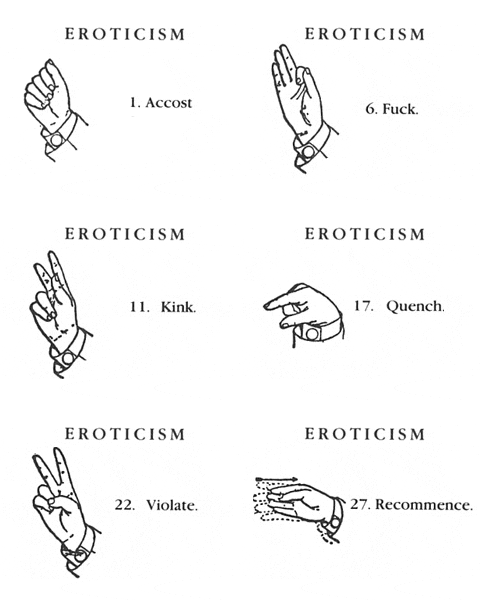
It's funny when the wide Internet ocean washes up two similar pieces of information in one week, but that's what I found on my shore. First, the always delightful Brain Pickings people posted a curious article about erotic Surrealist hand signaling.

Like so much about Surrealism, it seems laughable in its juvenile naughtiness. It's mostly crude jokes appended to the signs of the ASL alphabet.

But when you see two things about gestures, you need to take notice. And so, when I finished laughing at A Glossary of Gestures for Critical Discussion, I knew I had to share these...

The Critical Whirl. ‘I’ve read too much Marx and I can’t get my words out’
Circle hand clockwise in a small but rapid motion towards the audience. Accelerate and repeat until idea unpacked.
Though these are just silly coincidences on the web, they call to mind a few things...first I think about the way gestures and speaking are related. I've been reading a good deal about the origins of language over the last few years in hopes of putting together a class, and I've been fascinated by some of the ideas I've encountered.

Closely related is the way that gesture clarifies communication - I have heard stories about when the telephone was new and how people couldn't quite communicate through it clearly, lacking facial expressions and gestures. Even now, we have to supplement emails and postings with punctuation and hints about the emotional tenor of our messages ;-)

Finally, I was thinking about Andrew Solomon's doorstop of a book, Far from the Tree: Parents, Children and the Search for Identity, with its detailed discussion of deaf culture. These are, of course, not about that, but they do imply the limits of speech and the need for us to have recourse to communication by other means....Solomon poses an interesting question about ablism in his book, suggesting that deafness is not - as it is so often figured - a handicap of 'deficiency' as a form of 'horizontal' identity, a term he invented to describe the kinds of communities we join that are not passed down to us through genetics, heredity, or tradition. From time to we all need to join other communities, and these sites talking about gesture codes play on that need in a small way...

Saturday, December 28, 2013

Sudden changes

It's a strange feeling when you have a number of paintings going over a period of weeks and then, all of a sudden, you have a number of paintings nearly done all at once. That's what happened this week - all at once it seems five paintings are in the final phases and I am just tidying up...Here is a picture of new one (which takes a phrase from Roland Barthes: "It is the act of writing that subjugates pictorial gestures so that to paint is never anything but to inscribe")


I am still messing around with solids for the Impossible Books, too, and here are some other pyramids...these are made from equilateral triangles and fit together very differently than the ones made with right triangles...I am still getting the hang of reconciling what I think a solid should do in space and what it actually does. Definitely I was not wired for sculpture...


Monday, December 23, 2013

Impossible book models

With my sister, Mary Beth Brown, I am working on some models for a show in February at Philadelphia Sculpture Gym called Impossible Books. Early on, we decided that 'impossible' books were text books and have tried to deal with that problem...I'll flesh out that idea in writing in the weeks ahead, but here are some photos of the first of what I hope will be two or three models...

Each unit is part of a text about principles that guide the study of American History in a freshman class...

...they will nest in a structure within which they can be rotated and considered on various levels...

We're thinking of 3D printing the pyramids and cutting the framework from wood...just wrapping my head around the geometry is a bit of a trick right now...

Wednesday, December 18, 2013

Anonymous Shiva Linga Paintings at Arcadia University Gallery

Installation view of "Anonymous Shiva Linga Paintings"

I have been trying to get out to Arcadia University Art Gallery for a few weeks. As everyone in Center City Philadelphia knows, it's a trek...but it's worth it.

This is especially true this month, as the gallery has mounted an unusual exhibit of meditative works from India, Anonymous Shiva Linga Paintings.

The Illustrated Encyclopedia of Hinduism describes linga as a "mark" or "sign" but also as the "name of the pillar shaped form of the god Shiva." Because Shiva is as a generative force, the pillar-shaped form he takes is described as kind of 'phallic symbol.' Evidently, Shiva is worshipped in this form as the result of a curse put on him the brahmin Bhrgu. But it's interesting to dig around a little on this and to learn that the linga and its cousin, the shalagram are forms of 'aniconic' images; symbols that are intended to represent deities. The way the linga is discussed in the literature I encountered suggests it is primarily a sculptural form, but in this exhibit, various forms of ovals play the part.

The paintings are riveting. Arrayed on three walls of the gallery are about thirty five pictures, all vertical in orientation (like portraits), none larger than twenty by sixteen inches. Each is hung on an invisible horizon that encircles the gallery, so they are all about level with the head of a person of average height.  Framed under glass, the paintings dimly reflect your face as you look at them. The majority of the paintings are broodingly dark, like cartoon holes. Some of these seems to be eclipsing rings and busts or color that shimmer and peek out from behind the dark forms. A few paintings are built on vibrant colors, which seem shocking in this context. An ovoid burst of Pepto-Bismo pink appears to raise cerulean eyebrows in a 1994 picture described as being from Sanganer and New Delhi. In another, a dark rose lozenge is criss crossed by pale blue gray droplets of paint. One senses that everything is planned; in some pictures the central form has straighter sides than in others, giving it a different gesture or attitude. In a few, as in a 1987 picture from Jaipur, it wears a necklace of three dots. Occasionally, a tiny dot appears within the form below the center, like a kind of painterly belly button.

Anonymous tantric painting, Shiva Linga, 1972, Jaipur unspecified paint on found paper 13.75 x 9.25″ 
All are painted on rather fragile and forlorn looking scraps of paper. Writing appears to be struggling to pass from the back of some sheets and into plain (if backward) view on the display side. Here and there, it looks like conservators have tried to patch thin areas of the paper. Effulgent mists of red, blue or yellow paint (or is it ink? India has a long tradition of watercolor painting...) drift lightly across surfaces. Sometimes little holes of have been worn through by painting and one gets the impression that they may have been been created by intense gaze.

Looking at the paintings slowly and in succession, one understands their meditative function. It's hard to imagine the abundance of them in the gallery is anything like the way they would be used in the world (in fact, the gallery notes mention that "When complete, the paintings are pinned or pasted to the wall at home to foster private meditation, eventually to be replaced by another fresher example"). On the cold and quiet winter day I visited the gallery, it was easy to pretend this was a space outside of the art world's usual hustle and bustle of make-believe commerce, but it wasn't so far outside of that as to preclude feeling a little strange looking at ostensibly sacred objects in an avowedly secular context.


The crossroad of the sacred and the secular becomes an important aspect of the exhibit. Being very spare and abstract, the paintings seems entirely different from western devotional art. They appear to appeal to the kind of general spiritualism that has replaced organized religion in contemporary life...despite being firmly rooted in a specific set of religious texts and imaging conventions. Gallery notes observe "an uncanny affinity" between these works and "examples of 20th century abstract art from Europe and the U.S. (works by Paul Klee and Agnes Martin are frequently cited as examples)". Those of us who have sat through secular sermons that 'justify' non-western art in terms of western modernist aesthetics will, I hope, be forgiven for rolling our eyes.

The idea of anonymity in today's art world, saturated by celebrity as it is, is strange enough. The idea that a work of art could be a useful object, one that focuses attention, limits distraction, and encourages meditation sounds revolutionary. Walking through the show, I was, more than once, put in the mind of Philadelphia painter Quentin Morris, whose Buddhist sympathies inform his monochromatic paintings and drawings. In the gallery notes, we read of the French poet Franck Andre Jamme, "who has played an instrumental role in introducing these works to western audiences." Jamme has an interesting story, and was apparently entrusted with access to the paintings after considerable hardship. It feels strange to have such easy access to them given how well-concealed they were - until relatively recently - in the religious communities from which they originate.

So how far would you go to see something really great? The magnetic pull of New York is inescapable in Philadelphia (and this exhibit came to us through NY's Feature Gallery), but people seldom talk about going to Baltimore, DC, or Chicago to see great work...let alone visiting the West Coast or traveling abroad. There are whole art worlds in these cities in the shadows of their respective megamuseums. What are these artists doing and thinking?

I'm not of the economic strata that can plan my travel around exhibits in London or elsewhere  (even Baltimore...), but I worry that we are getting a little local in our art viewing...that a diet of a few galleries interrupted from time to time for an art fair is good enough and that when we come face to face with something strange and wonderful, we'll see it only through what we already know. With the collapse of the art criticism world, I cannot count on reading about shows in other cities as easily as I once could, and that's terrible. If those who don't know history are doomed to repeat it, what happens to those who don't know what's going on around them?

Tuesday, December 17, 2013

Speeding along

So for the last large pictures, I made up this crazily complex system of masking and stenciling. It was a great acceleration over the first iteration of this idea earlier this fall (where I masked each value of each hue in sequence), but it still seemed to take forever (really, it took six weeks to make the paintings...)

This time, it seem to have figured it out smoothly enough that I can rip through this process. Here are some pictures of another new canvas, where I was able to get two colors on in one day. Hopefully done soon...stay tuned!


Monday, December 16, 2013

Grad panels, a 'circle-of-life' thing...

Mark Tansey, Triumph Over Mastery

Early December: time to look at what the grad students are up to this year.

A few years back, I wrote a little bit about grad panels, and once again I am losing sleep over them. I am doing a lot fewer this year than most as I am out on leave, but I still need to join in for a few. Going this year is odd, since i haven't been in any grad students' studios. I am part of some gray facade of higher ed this year...the committee member no one really knows.

Add this to the fact that I cannot keep straight the rituals of various schools (is this the school where we ask the candidate to leave and wherein we have the real, substantive conversation in his/her absence, or is this the school where they stay and we are awkwardly keeping comments to ourselves for a few minutes?) and I am a mostly useless committee member.

Except for one thing: I am honest and I have no stake in anyone. 

I hate committees where people know the candidate and overlook obvious shortcomings of the work or the thesis. I fear ever being that teacher, one who has formed an attachment to a student that precludes clear-eyed evaluation of the work. 

I did three meetings in a week, and I've seen too much of that. When the work is good, it makes you play the downer, pointing out some way in which it could be better. When it's less than good, you are the one whose impatience at being a part of the conversation colors the whole meeting.

All of which leads me to ask, why do we do these panels this way? When I was in grad school, a students could select a panel of more-or-less total strangers (you know, the sort of people who might go see shows?) They didn't talk about the work as though you were going to revise anything; they talked about it as a thing that was done and sitting in front of them that needed to be figured out in 40 minutes. They didn't want to make better, they wanted to understand what it was. It was the best thing in the world - you saw how the work played to people who hadn't been listening to you figure it out for 15 weeks. They would never see you again. They told you it was great. Or that it wasn't great. Most of the time, they split the vote. 

As I get farther and farther in my teaching career, I get more and more clarity about what I can and cannot hope to do as a teacher. I see a lot of my colleagues trying to change lives. I hear a lot of conversations about teaching predicated on recalling 'that teacher' who changed your life. 

I have had great teachers. I have learned a lot, and I'm grateful to the many formal teachers I have had, and to the colleagues I learned from. But I can't get on board with the mystical, charismatic teaching ideal. What I see every time I sit down with students shows me that that's a bad idea. What I want to see is work.

Work in the studio..."What lies at the heart of everything is not fire"

After the making a litho this summer, I thought I would try rationalizing my application of color, moving from light to dark and doing a whole hue family at once...

The stencils get kind of intense....


...as the painting comes together, I have to start a punch list of revisions to be made. This is when the planning pays off...I know what I did and how to fix it...

Getting very close to finished here...I like the gradient space the word cloud sits in. A few more tweaks and we'll be done.


Tuesday, December 10, 2013

Found while preparing next semester's classes...

"'Words, those guardians of meaning, are not immortal, they are not invulnerable,' wrote Adamov in his notebook for 1938; 'some may survive, others are incurable'. When war came, he added: "Worn, threadbare, file do down, words have become the carcass of words, phantom words; everyone drearily chews and regurgitates the sound of them between their jaws.'" (21)

"We have histories of massacre and deception, but none of metaphor. We cannot accurately conceive what it must have been like to be the first to compare the color of the sea with the dark of wine or to see autumn in a man's face. Such figures are new mappings of the world, they reorganize our habitation in reality. When the pop song moans that there is no new way of saying that I am in love or that her eyes are full of stars, it touches one of the main nerves in Western literature." (23)

George Steiner, After Babel: Aspects of Language and Translation

Saturday, December 07, 2013

Tuesday, November 26, 2013

A slow down

I've been hugely hung up by technical problems this last week (like the death of my computer and the concurrent disappearance of hundreds of photos and studio files that went down with the hard drive). These have also caused big workload shifts, so I am missing deadlines aplenty...

I have a few interesting things to share...first, I was taken by this conversation on The Takeaway about the way social media use affects student writing. My teaching career started only a few years before Facebook, but blogs were already a big deal. At the time I felt (and I still feel) that students are very good at writing about their feelings about a given topic, but not so much good at writing about that topic. I doubt social media can be blamed for that. And anyone who equates texting with writing is looney.

They other notable item was a conversation on WHYY's Radio Times with poet Kenneth Goldsmith, whose book, Seven American Deaths and Distasters, is on my Christmas list (hint, hint). I am torn about what I think about the avant garde poet some call Kenny G. I enjoyed his book on Uncreative Writing, but when I heard him speak on the radio, he came across as more flippant than I would have hoped. It didn't help that from time to time he sounded like William Shatner...

...I will be back to this soon, and with photos. Thanks for your patience!

Thursday, November 14, 2013

Playing by rules

One of the main objectives of this break was to find a way to use my own writing in my work. 

I still hate that idea.

But it's necessary, given one can't read enough to have endless material at one's fingertips, and there is a rather narrow spectrum of things that seem paintable to me in what I read. Also, it would be nice to read for pleasure from time to time, rather than to always feel like what I am doing needs to be used in the studio...

But I can't just sit down and write something for a painting. It seems there needs to be some kind of structure. Structure provides important guard rails for creativity and no one knows this better than the writers and artists of the Oulipo.

So I looked at my paintings for rules. One obvious rule in the signal flag paintings is that three letter words work well (I've known this for a while, but been unable to act on it). I thought it would be okay to allow six, nine, and twelve letter words, too, as those fit nicely. I decided to take the cue from the size of the canvas on which I wanted to work instead of letting the text dictate the scale. So I chose four-foot squares somewhat arbitrarily (as in, I had these stretchers and they weren't doing anyone any good without paintings on them...).

I mapped out a number of arrangements of flags, some with thirty blocks, some with more. I have settled on a thirty five-block arrangement, which means I need to come up with 105 characters in three-, six-, nine-, twelve-, or fifteen-letter words.

Easy right?

I've been posting about the progress of the first one, and here is a picture of it nearly complete:


It reads:
Before the end, you forget all the images and sounds placed before you Deceitful script surrounds you and cryptography begins.

I am starting the second one, and just composed the text:
The secret languages you use are sad and opaque metaphors camouflaging poetic worlds and revealing our tragic aestheticism.
I suppose it's predictable that they would be about language, but I found it a little funny that they are so consistent. Working on them is pleasantly maddening, like trying to solve a puzzle. I think I have a few more left in me, and I imagine these will go one for a little while yet. I keep coming up with fragments...
She alphabetized disasters
Our pictorial mentality mimics tragedy
The pictorial messenger
Ask our regretful god for energy
Adults cry out for the crappy symbol
Idiots see misplaced deceit
that I hope I can use...

Monday, November 11, 2013

Tuesday, November 05, 2013

More progress...


Work in progress...

I started a new canvas in the studio the other day.

At four-feet square, it's large for me...

Underpainting is, always when I work large, a huge issue...
 
Fortunately, I'm finding ways to be efficient about the stencils... 
Now we're ready to start encoding the message...


Thursday, October 31, 2013

Halloween

Not sure why, but I have been drawing skeletons for a few weeks now. I was definitely inspired by the charming catalog of the Puro Muerto show a few years back at the LA Public Library...I know I made more than a few small pictures of skeletons when I was in school, very much influenced by the images in European painting and printmaking...

Either way, Happy Halloween!

I think I know where this one came from...


This one was in a dream the other day...
I start things by copying. This couple was in the Puro Muerto book, but they inevitably turned into my glamous wife and me (below)

I still think copying is  agood way to learn something...or at least I hope it is becuase it's how I start every project...

Sunday, October 20, 2013

Another iron enters the fire...

When I visited Matt Sepielli's studio recently, he told me about his upcoming project for Temporary Allegiance at Chicago's Gallery 400. He was kind enough to encourage me to check it out. 

I found a quote I'd like to work with, one attributed to Sinclair Lewis:
When Fascism comes to America, it will be wrapped in the flag and carrying a cross.
I have found a good fabricator and starting making drawings...


Hopefully this will get done fast...I could use the thrill of finishing something...

Friday, October 18, 2013

Dying Languages

In June, 2005, Elizabeth Kolbert (writing in the The New Yorker) poignantly described an emerging crisis in world langauges. Focusing on Eyak, Kolbert called attention to the phenomenon fof language extinction adn described efforts being made to preserve languages that are being erased adn forgotten as populations migrate, assimilate, or disappear into the fog of mass communication.

I was reminded of this sad story when I saw images of remarkable paintings by Moroccan-born artist Hamid Kachmar, on view at Boston University's Sherman Gallery. Here's a passage from the gallery's description of the show:
In Reviving the Ancient Tifinagh Script, Kachmar renders the ancient Amazigh script, Tifinagh, into textual and visual compositions that represent a struggle for identity, cultural survival, and self-conception. For centuries, the Tifinagh script has been politically suppressed; painted out of Amazigh people’s collective consciousness. For Hamid and many other cultural activists of his generation, Tifinagh represents not just the ancient script of a still widely spoken indigenous language, but also a symbol of the struggle for cultural survival.
a painting by Hamid Kachmar

Wednesday, October 16, 2013

Black Flag - Richard Dawkins


It occurred to me the other day that I needed to make a black flag. I had been messing around with text from Beowulf, but it was hard to get it right...very difficult text chosen for rather sad reasons. I went back to a favorite passage (by Richard Dawkins, used in James Gleick's remarkable book, The Information: A History, A Theory, A Flood) and made this...I think I am going to be making a large canvas this way soon...

The text reads:
What lies at the heart of everything is not fire, not warm breath, not a spark of life, it is information, words, instructions. 
I have been planning to make a large, shaped panel version of this, but it is beginning to look like that's not going to happen on this sabbatical. I have run into long delays getting the panels made. I will have to re-direct.

 I suppose one of the lessons of this is not to put too many eggs in one basket...

Sunday, October 13, 2013

Review: The Flame Alphabet by Ben Marcus


I have a slim bookshelf of plague fiction. It's an unsettling corner of my library, one that shines a light on human self-interest and indifference. Of course there's Camus' Plague and Saragamo's Blindness.  The Flame Alphabet shares a lot with these books - like them, it is full of things from the world we know. Telephones and copper wires. Cars, houses, trees, and children. But it also contains things that are not of this world - mysterious illnesses that stem from children's speech, holes in the woods that carry sermons to lonely worshippers.

As a work of largely experimental fiction (it's encouraging and a little hard to believe how many mainstream outlets blurbed the book), The Flame Alphabet suffers from a certain almost autistic emotional coolness. I found this much more readable than Marcus' earlier book, The Age of Wire and String, in part because the author does an astonishing job capturing the confusing, destructive love of parenting. Characters labor in ignorance long after you know what's causing their illness, and when ignorance no longer serves, they turn to denial for comfort.

For me, the passages in which the book treats language as a real thing are most engaging. For much of the second part of the book, we see minute descriptions of the act and effects of writing. These are captivating, and one begins to see the world slightly differently. The proliferation of signs and messages in the semiosphere takes on a quality of menace. William S. Burroughs described language as a virus and Marcus carries that idea to an extreme point, giving readers a world in which symbiosis is no longer the routine and where overexposure has catastrophic consequences.

What do we get from reading plague literature? From Camus, I got a strange reassurance of the agency and fundamental goodness of mankind. From Saragamo, I got horror - a sense of how we are ultimately wired to take advantage of any situation. From Marcus, I get a sense of the destructive power of love, of our unwillingness to leave a toxic situation long after it has begun to kill us. I could wish for an ending to the book, and for the resolution of many of its open questions about the motivations and outcomes of characters' actions, but I am satisfied with what I got: a thoughtful consideration of language, an allegory of parental misery, and a chance to ask myself, in a disaster like the plague described here, who which one of these characters would I be?