This summer, an artist I know came up with a project in which a number of people shot photos using disposable cameras and sent the unprocessed images to one another. I pre-visualized mine with a digital camera...I am looking forward to seeing what the disposable camera got, but wanted to share the project's images here...
...a bulletin board for recommended readings, random musings, and reactionary responses in a post-social networking world...
Saturday, August 11, 2012
Thursday, June 14, 2012
Three-Letter Literature
Jeff Buddle:
"Ode"
Why not try?
Who can say?
The old man?
Fie! Let him
rot. Try now!
Tony Bures:
You may ask who led who?
How did bee and owl die?
Why the red sky?
The air run out and our pen now dry?
Kristan Campbell:
may eye
one fly
the one
not yet
you die
our fix
not let
you cry
the mix
lip fun
can dye
our ash
can run
the sky
Bee not sadMatthew Parrish:
Sis, wee fly
Fox our day
Bat the sky!
Eye per owl,
Rat out foe,
Lie, jaw, yak,
Ilk nor doe.
"Out"
Hmm, hum, aha!
Sip rum and see the sun
set sky. Dry off,
pet the dog, toe tap,
hit the bed,
end the day,
her age.
Cecilia Snyder:
Cat has fun fur and
will let you tug and pet him
now rub his shy tum
Sunday, June 10, 2012
The Abstract Engine
It must have been a slow news week because the Wall Street
Journal gave over space to Terry Teachout for an essay on "The Seductive Lure of Abstraction.”
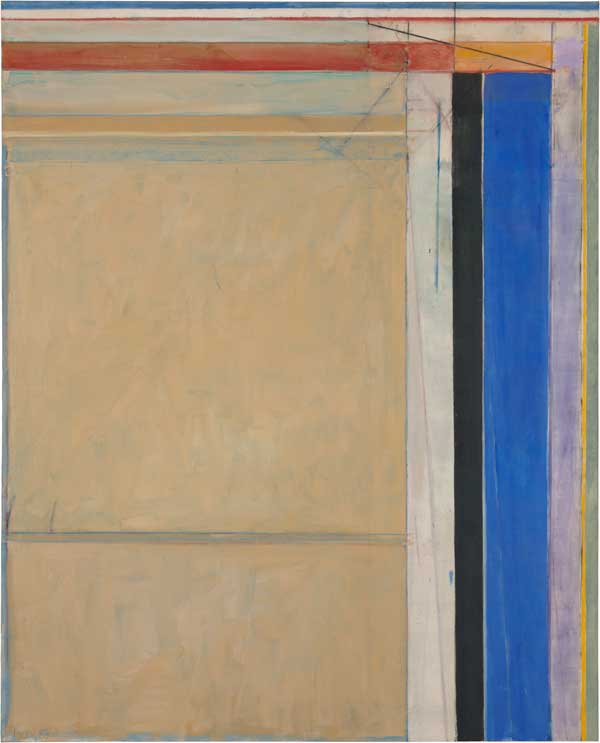
Teachout takes the occasion of a travelling exhibit of Richard Diebenkorn paintings as an opportunity to muse on why people care about
abstraction in the first place. This may be a question that still stumps
readers of the Wall Street Journal, and as much as I admire Teachout for trying
to answer it, I found his response a little tired. He couldn’t stick to the
problem at hand, often wondering away from the subject of painting to dance and
music – as if imagery and narrative were really the same thing. Let’s take
another go.
| Richard Diebenkorn, Yellow Porch, 1961, oil on canvas,70 1/2 x 67 in. |
Anyone who looks at a 60’s Diebenkorn ‘landscape’
and a mid-70’s ‘abstraction’ like one of the Ocean Park paintings will
immediately recognize how fragile the wall that separates the real form the
abstract can be. Why is abstraction framed as ‘seductive,’ as if to succumb to
it is to be, in some way, unfaithful to representation?
Richard Diebenkorn, Ocean Park #83, 1975. Oil on Canvas, 100 X 81 in. Corcoran Gallery of Art, Washington, DC. |
Realism as we know it didn’t exist until the mid-19th century when certain artists started to portray subjects familiar to the
growing middle class and to cater to that audience’s interests (which often
included a voyeuristic interest in poverty and hard circumstance)…things that
seemed ‘real’. Compared to what? To the religious and historic subjects
supported by the patronage class of the late 18th century, of course. Concurrently, many
artists of the late 19th and early 20th century were
drawn to abstraction by growing certainty that painting could be like music –
that it didn’t need to refer to stories to be moving, that it could be
beautiful based on its own formal properties. The fact that such views
constituted a shift from the previous generation – a means of making
two generations distinct from one another and thus creating a new market where
none had existed before – seems like something no one wants to address. One
sometimes wonders if the imperative to ‘make it new’ wasn’t really motivated by
a horror of being seen as old…
But painting has – even when it carried water for its political
or religious sponsors – always been driven by an abstract engine. One need only
think of the legendary battles of skill between ancient Greek artists over who
could paint the thinnest line. Or of Leonardo’s advice to seek the landscape imagery
in stains and shadows on the wall. A hundred examples could be offered, and I invite you to add yours to the comments.
An artist like Richard Diebenkorn (or, for that matter, his
mirror image Philip Guston) who slides across some perceived barrier between
real and abstract ought to remind us of how entwined those things are – how
artificial our ideas of reality actually are and how abstract the world
actually is.
What makes Diebenkorn’s paintings worth talking about is
their quality of specificity – of being so certainly about something that words
seem to fail. (Teachout takes up the wordless defense that is so tired…artists
are always saying that their works are outside of language. Such artsits should read
more to see what people who use language can do with it…there’s a difference
between something being beyond words and being beyond my words...) In
Diebenkorn’s pictures, that sense of specificity comes in part from the way the
artist reveals the process of making the picture. One sees lines drawn and
drawn out, colors scumbled over colors, as if each decision were being made and
then questioned. As if something had been seen and then recognized as mistaken…the
pictures depict a world of second- and third-guesses.
When I go to see Diebenkorn’s Ocean Park paintings at the
Corcoran, it won’t be to cast a vote for the real or the abstract. I will go
because the paintings show me how false such a division is, and how much of the world they allow me to see.
Thursday, June 07, 2012
Stephan Sagmeister @ ICA | Erin Rose Boyle @ UArts
Stephan Sagmeister at the ICA.
Erin Rose Boyle's show Two Moms, Three Boys, Two Dogs is in an office at the University of the Arts.
| Little jokes like this are abundant in the gallery... |
Wednesday, June 06, 2012
Art Seen - Ellen Harvey @ Locks Gallery
Ellen Harvey's Arcade/Arcadia at Locks Gallery.
The etched mirror images reflect and echo...
a small image of Tuner's original gallery (?) is tucked into a corner, easily overlooked. It is, in may ways, a kind of key to the show. Thanks, Carmina, for pointing it out.
Apparently when installed in Margate, the pavilion was skinned with walls and ceiling. Here is it more skeletal, allowing the viewer to see in through the structural frame. It is especially interesting to see the guts of the work - its wires and joints.
Sunday, June 03, 2012
Art seen, June 3
I've been looking forward to seeing H. John Thompson's work at Napoleon. It was worth the wait...
A snapshot from the group exhibit Intramural at Tiger Strikes Asteroid. The clearing sky threatened to outshine any shows.
At Grizzly Grizzly, high-contrast paintings by Mark Sengbush and tiny sculpture by John Chewkun
I've also been looking forward to a chance to see Scott Kip's work, and was pleased to see the show at Marginal Utility.
Friday, March 30, 2012
Wednesday, November 16, 2011
Things that annoy me, volume 1,964
The other day I promised I would go through this and address its most irritating moments. I should stop making promises like this. They exhaust me.
Where to begin? How about at 35 seconds, where entrepreneur Steve Blank begins a riff on van Gogh's Starry Night, suggesting that when a painter sets out to make a picture s/he has "no idea what's going to come out". Let's put aside romantic ideas for a minute and just think about this...we'll assume that the painting Blank is talking about is the one in the collection of the Museum of Modern Art, painted in June, 1889...thirteen months before van Gogh's death of a self-inflicted gunshot wound. It's also worth noting that by the time he painted this picture, van Gogh had been working on his craft for nine years. Van Gogh was an astonishingly prolific painter, and some 800 canvases (and many, many more drawings) in his short career. In that short decade, his work underwent considerable transformation from early, gloomy works like the 1885 Potato Eaters. Such changes came - if one trusts art historians (or, for that matter, the artists' own letters, instead of the myths one prefers to invent because they make things so much more interesting...) - after van Gogh started thinking about Seurat's use of color, about the nature of Japanese art and prints, and through exposure to the pictures and ideas of Paul Gaugin.
The point here is that van Gogh didn't just randomly toss canvases on his easel and hope for the best. as Blank implies. At this moment in his reverie, Blank is trying to make a point about how entrepreneurs are not like scientists (rational operators? people who can achieve predictable results under controlled circumstances???) but rather that they are like "artists...but a special breed of artists [...] composers"
Mixed metaphors (artists/composers...what's the diff?) notwithstanding, let's move to 1:16 in the tape, where Blank, with infuriating smugness, observes, "we've been teaching art for hundreds, probably thousands of years in our society [...] yet we still don't know what makes world class composers." Please, Steve, don't include yourself in that 'we.' I don't see any studio teaching in your resume. But, for the sake of argument, let's pretend for a moment that over those thousands of years, no one had identified any principles about harmony, about form, or about any other aesthetic properties that could be passed down from generation to generation so as to constitute a tradition. Let's imagine that every artists figured it out for herself or himself...that no one ever successfully offered advice or considered how another generation might approach an art form. Let's say, because if I get Blank's meaning, that knowledge of how art has been made in the past is of no use to an artist in the present because the circumstances have changed. Then what does it take to make a work of art (or, a successful business, because Blank is really talking about entrepreneurship, not art, about which he evidently knows little)?
Well, duh, it takes an appreciative audience.
The creative act is not formed by the artist alone; the spectator brings the work in contact with the external world by deciphering and interpreting its inner qualifications and thus adds his contribution to the creative act. ~Marcel Duchamp
But acknowledging that works of art come not from brilliant, inspired (or loony) individuals but from our collective interest in what brilliant, inspired (or even, occasionally, loony) individuals make would seriously undermine a motivational speech whose primary message is that it's who you are not what you do that matters. I mean, who cares what you do anyway? It certainly doesn't matter in the arts, where all you really need is a name that can become your brand...why should it matter in business?
Anyway...at about 1:50, Blank talks about the 'irony' of giving scientific tools to people who are artists (note that entrepreneurs are no longer like artists, they are artists...Barthes would have something to say about the way myth is being used here...but fortunately the reader doesn't get any harder than Malcolm Gladwell). Steve Blank, meet Stephen Wilson, and David Edwards. I am as excited as anyone about the possibility that artists in the 21st century can all hang up our velvet smocks and do something new and innovative and (gasp!) relevant outside of the museum/gallery universe, but that doesn't turn every creative act into a work of art, and it doesn't mean that everyone who create something is an artist.
What I really left Blank's short and grating talk with was a strong sense of the self-loathing that entrepreneurs must have. If I understand it correctly, it's necessary for people starting businesses to come up with some alternate universe in which what they do is more important than what it is - in which the design, manufacture, and marketing of a new widget is of the same cultural consequence as a symphony. How about letting things be what they are? Entrepreneurship requires vision, organizational skill, risk-tolerance, and a host of other traits (that are, coincidentally, valuable for artists to possess as well) but dressing it up as an expression of a culture's values and achievements - turning it into a work of art - is a recipe for making fun of art and commerce.
Monday, November 07, 2011
Copyleft sing along
Thanks, Terri for this addition to the copyleft song book. It's like an updated version of Jefferson's comment about whoever lights his candle from mine...Remember, sharing doesn't hurt.
Saturday, September 24, 2011
New work
I put a few new images of things I'm working on for my show at Tiger Strikes Asteroid up on my site. Hope they amuse you...
Wednesday, September 14, 2011
Back to writing about teaching
Now that I'm teaching this large lecture class with a handful of other people, it seems I am getting a lot to think about and will try to use this blog as the place to put it...
Today we were talking to our huge section of about 180 students about research. We had done a poll at the first class meeting and found that huge majority thought research was an important part of art and design practice, but in another question we saw that they were not necessarily so comfortable doing it. So we asked them why they didn't feel comfortable in class today and the answers came back in high school, research was a highly prescriptive process and that it relied heavily on secondary sources and received wisdom.
We kind of expected this - and that's why we were about to launch a project that addressed observational research tactics - but my colleague, Sneha Patel of Tyler's Architecture program - made this really interesting observation at that moment. She pointed out that the students seemed to be hampered by the interface of research.
This struck me as really important, as if I had been confusing the substance with the means of recognizing that substance...as if there suddenly was some sort of wall between information and informed. Observation seemed like a useful way to pull down that wall, and to stand in direct relation to the thing you're trying to understand.
Of course, primary sources are that sort of thing, too, and they may be the only available way to 'observe'' someone or something remote in time or space, but I thought that image - of a wall - was a keeper...
Saturday, September 10, 2011
Monday, June 20, 2011
Artists - opportunity
NAPOLEON CALLING!
We'd like to welcome you to apply to be an original member of a new artist run project space. In the blossoming 319 N. 11th Street building which is home to popular galleries such as Vox Populi, Grizzly Grizzly, and Tiger Strikes Asteroid, comes NAPOLEON. NAPOLEON's mission is to give artists complete freedom to conquer space through experimentation and risk taking. NAPOLEON offers members free reign in the space for a month a year on a rotational basis. Members will be free to present their own work or curate a show in space 2L (225 sq. foot gallery). Once members are chosen, there is no more jury process.
Aside from showing at NAPOLEON, members will also help run the space by attending monthly meetings, gallery sitting, maintaining the space, and helping with various administrative tasks. While the gallery itself is the primary focus of the group, NAPOLEON could be much more. First year members will mold the reputation of the collective and set its agenda. NAPOLEON will be a group from which artists can find community and an artistic outlet. So, come be a NAPOLEON.
Eligibility:
- must reside in the Philadelphia area
- must be out of school (to avoid conflicts)
- must commit to one full year (August 2011 to July 2012)
Dues:
- $45 a month membership dues
- commitment to one full year membership
- commitment to meetings and gallery sitting
- Application: Please email napoleon.philadelphia@gmail.com
- 3 examples of your work (jpgs or short video)
- an artist statement
- a current resume
- 3 - 4 sentences about why you'd like to be in an artist run project space (may be written in the body of the email)
Application due July 20th. Email widely.
Thank you,
Daryl Bergman and Leslie Friedman, co-founders of Napoleon
COMING SOON!
napoleonnapoleon.com
July Show: Christopher Hartshorne, "Stark Matter." Two opening receptions! Friday July 1st and Friday July 8th. Come check out the space!
Character is victory organized -- Napoleon I
Monday, June 13, 2011
Friday, May 20, 2011
Virtual Studio Tour - Slideshow
I've been meaning to put this up forever - hope you find it interesting...
Virtual Studio Tour
View more presentations from gerard brown.
Friday, April 08, 2011
Interesting participatory design project...
Thanks to Polly McKenna-Cress for posting this link to the Center for the Future of Museums, who I will now be following.
I promise to one day write something original again (though I've notices that the sun continues to rise in the east even if I don't...). For now, thanks for checking in on this blog from time to time.
Thursday, March 31, 2011
Friday, February 25, 2011
Suggested readings
It's been very busy - too busy to keep up with this blog's housekeeping. I wanted to point to two things that interested me.
One was in the February 24 Washington Post Classical Beat blog. Anne Midgette makes a plea for critics to connect to others idea when publishing on line. This is a great idea - and its value to all of us comes into focus when she writes about how
The other thing I wanted to link to is The Guardian UK Theatre Blog, which had an exhortation for artists to write more about their work. Not more self promotional bloggiy crap, but
More soon. Really. I want to write about this book club I'm in and the book How Learning Works: Seven Research Based Principles for Smart Teaching. It's been interesting to think about learning instead of teaching...
One was in the February 24 Washington Post Classical Beat blog. Anne Midgette makes a plea for critics to connect to others idea when publishing on line. This is a great idea - and its value to all of us comes into focus when she writes about how
A new work, in particular, is in the position of the blind men and the elephant: everyone who was there can give his or her own piece of the experience, and readers, seeing them all together, can try to amalgamate them into a larger, and more accurate, picture.Critics' varying descriptions and assessments can offer readers a multi-dimensional view of a work. And I need that when I read...as I can't get away to see anything these days.
The other thing I wanted to link to is The Guardian UK Theatre Blog, which had an exhortation for artists to write more about their work. Not more self promotional bloggiy crap, but
a messier kind of writing, more vulnerable and yet more declamatory. Writing that is the product of a desire to speak as well as an obligation to communicate. A more restless kind of writing, devoid of neatness, riddled with ambiguities and rhetorical flourishes. Writing that expresses the same wants and preoccupations as that artist's other creative output, without needing to comment on that work. Writing suffused with generosity and fragility. The page as a canvas or a stage, as well as space for programme notes.I have been teaching writing in art schools for a while, and I welcome this idea wholeheartedly. Writing is not something one does merely to promote oneself - it's something that can explain one's self to one's self. It is the mind at work... and that's a pretty exciting thing to read (whereas boring, jargon-laced, self-promoting 'artists' statements' are not...)
More soon. Really. I want to write about this book club I'm in and the book How Learning Works: Seven Research Based Principles for Smart Teaching. It's been interesting to think about learning instead of teaching...
Friday, October 15, 2010
Coming attractions
If you're going to be in Richmond next week, come see:
Gone But Not Forgotten: Recovering History int he 21st Century
with panelistsJane Irish, University of Pennsylvania
Consumed By Painting: Commemorating + Reenactment +Internalitzation
Wendy Deschene, Auburn University
My Latest Inheritance
Christine Colby, The University of the Arts
The Allure of the Fantastic: Reflections of the Past...in the Present
9:45am Harrison Meeting Room of the Jefferson Hotel in sunny Richmond, VA.
Details: Curiouser
Publish Post
Monday, September 13, 2010
Found
"There is a book (or at least a glossy catalogue) yet to be written, not on the art of the '80s but on the ramifications of the art of the '80s on all of us who were too young to actually participate but old enough to be schooled in it. My sense is that much of the work produced by this group today is the visual equivalent of the poor soul who was really smart in school but never fit in socially -- you know, the one you would always get drunk at parties just to see him do something stupid and completely out of character. Hovering precariously between a critical knowledge that has resonated so loudly and for so long that it is impossible to forget and a new world that says a big whatever, we go through our art life like a conflicted Fred Flintstone, angel and devil Freds popping up out of the blue to whisper conflicting truths in our ears."
~Charles Kissick, Border Crossings, August, 2009
Subscribe to:
Posts (Atom)