Near the end of graduate school, I started a project I've been working on very slowly over the years, I asked 50 friends to contribute 20 favorite words that would constitute the literary spine for a picture. I've finally begin getting images out of this mass of data, so I will post them here from time to time, but I thought it would be good to post the original list as a preface.
a, Abba, abecedarium, academic, accent, actants, address, adhere, adjective, adoring, adverb, adz, aerial, afloat, Africa, agents, agitator, alchemy, alligator, align, alizarin crimson, alkalization, Amen, amoebae, amphitheater, and, anima/animus, animation, annihilate, ant, anthrax, anticipation, antique, any, anyway, apocalyptic, appointments, aqua, architect, arson, art, as, asked, Assata, associate, astronomy, Astroturf, at, avant garde, awkward, ayer, back hoe, ballet, banal, barrel chested, basis, bastardized, bat, bayou, beauty, bed, bed sheets, beefy tee, behavior, believe, bella, Bellini, betray, bicycles, binder, bird, black, blissful, blond, blood pudding, bloom, blossom, blue, boil, boll-weevil, bologna, bolt, bonkers, books, boss, bottle, bounty, bow, Braille, brand, bratwurst, Brazil, breath, breathe, bridge, Brock, broke, bronze, Bronzino, Brooklyn, Brown, brushing, buck, buckle, bunny, butterfly, button, buttons, by, caduceus, cake, calculating, calibrate, California, callous, calming, camera, can't, cancellation, cappuccino, car, cardamom, cardigan, caricature, carpet, carriage, cartography, casket, cat, cataclysmic, catchword, catharsis, cavort, celebrate, celebration, celibate, cellar, centipede, cerulean, chain, chairs, charismatic, chartreuse, chiaroscuro, Chicago, Chile, chives, chocolate, chocolates, chrysanthemum, chum, chunk, church, ciao, circumlocution, circumstance, civility, clamp, classified, clause, clean, closure, cloud, clunker, cob, coda, coddle, coffee, collective, columbine, combination, comer, comida, commandment, commercial, comrade, comunitas, conjunction, connect, connected, consumed, context, conundrum, conversion, cooperation, copacetic, copper, corn, corny, corollary, corpse, corsage, cotton, count, counting, courage, cradle, crash, crazy, create, creative, creature, creepy, crime, critic, critical, crosshair, crossover, crud, crusty, crystal, crystallize, Cuba, cunning, curve, cut, dagger, damar, dark, daydream, Dear, death, deck, deferential, denouement, deploy, desirous, devilry, dextrose, dialectic, diet, dignity, dinner, dip, dirt, disappointment, disarticulate, disco, distance, disturb, do, dog, dogma, dominion, door, dormant, double mint, Douglas, down, dream, dream catcher, dreams, dregs, driving, dry-clean, dumpster, dunes, duty, dynamite, dynasty, dyslexia, dystopia, e-mail, eagle, ear, earth, earth, eep, eggs, egregious, elbow, electric, elegiac, elf, embarrasses, encompassing, end, endure, energize, energy, engender, entrance, entreat, entropy, eponymous, equilibrium, erp, esteem, Etruscan, Eucharist, every, excavator, exercise, exigent, exit, experiment, explorer, extension, extension, face, fad, fade, failure, fair-weather, Fairchild, faith, faithful, fall, false, family, fancy, fandango, farewell, fedora, feelers, feet, feet, fell, fellow, fesnoo, fester, festoon, fez, fibrillate, field, fill, finial, fish, Fish's Eddy, flaneur, flannel, flare, flattened, flea, flooey, floralist, flower, fluid, flush, fly, focus, foil, footnote, for, force, fork, forlorn, forsake, fortunate, forty-two, foul, fountain, fourteen, fragile, frame, free, fresco, fresh, Friend John, frizzy, from, frontal, frou-frou, fruit, full, fun, funny, fuss, futon, gabble, Gabrielle, game, gamut, garbage, garden, garrulous, gelato, gender, general, generous, geometer, geometrical, geometry, Gerard, gerund, gewgaw, giggle, giraffe, glance, glass, glassware, global, gnome, go, gob, God, gold, goober, good-bye, goose flesh, gorgeous, grandmother, goofy, grass, gray, green, grieve, grunt, gush, gym, ground, haiku, Halifax, hamper, hand, hangnail, happenstance, happy, hard, harmony, hash, haste, he, healing, hear, heart, heat, hellcat, here, heroic, herring, hero, high, hiking, hinge, heterotopia, hmmm, hold, home, hip, hoopty, hope, home, hotels, howitzer, Hoyne, hose, hunger, hydration, human being, I, ice, ideology, idiom, illuminate, immorality, impending, impish, impromptu, impossibility, in, incandescent, incubus, indeed, India, incense, infinitive, infinity, inflammability, inebriate, information, information, infrastructure, inflect, inside, insistent, insouciant, inoculate, intellectual, intense, intention, instant, interiority, interview, inundate, interdisciplinary, investigation, inversion, is, isosceles, it, iterative, Japanese, jet, joy, juice, just, kine, kitty, knock, knowledge, la Coeur, lackluster, lake, laser, last, lazy, lamp, lemonade, letting, lexicographic, leisure, light, lighthouse, lightly, life, lily, limitation, limned, like, lion, list, listen, linen, lofty, lollygag, long, loose, loosen, lots, love, low, love, Lucerne, ludicrous, machine, magazine, magenta, magic, Mama, mandate, manner, marble, marbles, manna, marsupial, masticate, materiality, Maria, mayonnaise, meaning, meddlesome, meeting, memoranda, memory, Memphis, merkin, Michigan, mimesis, mimetic, mersnoo, mire, mirror, misanthrope, mimic, moat, mode, moist, missing, moment, Mommy, money, monkey, moon, moon, moralist, moon, morning, mosquito, moth, moth, mourning, mouse, movement, mundane, murmur, music, music, murmur, my, musk, narcissus, navigate, nebulous, needle, nasty, Nero, nerve, new, neighborhood, next, nice, nicety, niggardly, nip, night, nine, ninety, night, no, nocturnal, nomad, non sequitur, nonsense, nodule, nonsense, north, noun, now, nozzle, obfuscate, obsolete, obstreperous, ocean, oeuvre, of, okay, oil, on, on-line, one, onomatopoeia, oof, open, one, optimistic, options, opium, orange, orphic, Otis, orifice, overslept, overwhelmed, oxymoron, overcome, painter, palfrey, papa, padded, paradigm, parents, paper, past, pastiche, path, participle, pedestrian, pelt, penultimate, paucity, perfunctory, phantom, pheasant, people, phoneme, piddle-paddle, pillows, philology, pine cones, pink, placement, plane, planning, play, placenta, plenty, Plus Ultra, polymath, pleasant, polymorphous set, Polynesia, porqué, posing, posthumous, postulate, practical, possibility, previous, princess, prism, present, problem, prosaic, psychedelic, psychic, public, puddle, puissant, quack, query, question, question mark, quid, quake, quip, quirt, quoin, quiet, rabbit, rabbit, quotidian, rain, rainy, raspberry, radiant, re-entry, reader, red, ratio, red-soldier, relation, relinquish, red, Renaissance, renovation, repetitive, reliquary, reverie, rhinoplasty, rhomb line, restless, ride, rifle, ring, river, rhyme, road, roar, rock, rocket, Roma, roots, rose, round, rooftop, run, runaway, sable, route, sadness, saint, salad, sad, salty, Samson, sandwich, saline, Saskatchewan, sate, Satiricon, sandwich, sausage, say, schism, sauce, science, scooter, scribble, school, sea, seal, season, scrofula, sedition, seek, seepy, seasonal, selfish, senescence, secret, seer, seventeen, sew, Sesquipedalian, sex, sexo, sfumato, shine, shiroi, shell, shoals, shod, shoe, shovel, sidelong, sight, shopping, silence, silly, simpatico, silence, sip, Situationist, skirt, since, sky, sleepy, sloth, slow, smarty-pants, slippery, snake, sneep, snide, smelly, snirk, snoop, snow, sniff, so, soaring, sock, sole, somersault, songs, soothe, solidarity, soul, sound, sound, sorrow, space, space, spank, soup, spectacular, sphinx, spider, spare, spirit, splendid, spring loaded, spinach, squib, squire, squirrel, springtime, stanza, stellar, stercoraceous, stand, stop, storm, strabismus, stone, strap, “strategery,” stream, strain, strength, strenuous, stress, streets, struggle, struggle, studio, struggle, stupendous, suffice, suit, stuff, sun, sun, sunshine, summons, surrogate, survey, sustainability, super, Swedish, sweep, svelte, sweetness, swim, swimming, sweet, sycamore, sycophant, syllable, swing, syringe, tack, tactile, sympathizer, take, tampon, tawdry, tailback, team, tea time, tell, teal, tender, tent, tenure, temporary, tested, Thanksgiving, that, the, thermos, think, this, thistle, third, threat, 3-D, threshold, threshold, thought, thumb, thumbprint, thump, tickle, tied-up, tiger, ticking, time, to, tile, toastale, tomato, tonal, tongue, to-do, tonic, too, topiary, tonic, topography, torment, torque, topobiology, tourist, Toussaint, townie, tour, traffic lights, trail, train, traffic, transcendence, transgress, transient, trajectory, travel, tree, tremor, tree, triumph, trope, trouser, trench, trustafarian, truth, tulip, true, twitch, two, 2-D, 2001, type, U-haul, unctuous, underwear, uh, unique, up, UNICEF, utensil, uterus, utopia, urban, vacillate, vase, vassal, uxoriousness, verge, verism, vernacular, Velcro, versus, vertigo, vestigial, verse, vintage, virtual, visionary, Vienna, visual, vowel, vista, walk, walking, walkman, waffle, waltz, warm, warning, Walter, warthog, was, wash, warrant, waste, water, watershed, wave, web, weekly, weep, waver, weird, well, well-mannered, weevil, whelp, which, whine, what, whisper, whisper, white, whippersnapper, white, why, wild, will, willow, wind, winsome, winter, wing, wonder, wood, wool, work, yashmak, yearlong, yellow, write, yes, yesterday, yellow ochre, you, you're, your, zebra, zephyr, zipper, zooks, Zorro.
Saturday, January 24, 2009
Wednesday, October 08, 2008
Some thoughts on On Teaching and Learning
Note: I was asked by a friend who runs a website that collects stories to write about teaching. It didn't work out, but I wanted to post the piece on this blog to get some ideas I had while working on it aired out. Comments are welcome.
From go, I knew that my work was slow to develop and that I wanted teaching to be a big part of my professional life. So I paid attention to teachers who I found effective.
Problem was I paid attention only to those who taught me, not those sitting in the classes and studios where I worked and studied. Thank heaven not every student was like me. It’s enough to say I learned the most from teachers who could teach students like me, ones who might politely be called ‘focused’ but who might more accurately be described as obsessed, or even nuts.
This became apparent when I was first asked to teach a workshop on piecing and quilting. That my students might have enrolled because they had a curiosity about the medium rather than a consuming obsession struck me as odd. Why go to the trouble of taking a class if your desire to know about this was any less than unbearable? Why not teach your self? That these students might have been smarter than me (they were) and realized that teaching is not a form of indoctrination but rather the transfer of knowledge was…well, it wasn’t how I approached being a student. As a student, I have enormous appetite and probably unhealthy appetite. As a teacher, I had to learn how to prepare meals – even courses – that were digestible.
So I had to learn all over again how to be in a studio or class room, how to listen to where my students were coming from and not try to cram everything I knew about a subject into a single session or even semester. I had to learn that people come to learning for a variety of reasons, and that they bring with them an astounding range of skills and experiences that may facilitate or complicate their education, but which nonetheless enrich it. I had to learn that the knowledge you convey as a teacher is a neutral power, and it’s up to the student to use it for good. As a teacher, you can model ethical behavior, but you cannot dictate it.
Teaching gradually shifted for me from a form of evangelism to something else. Rather than seeing myself on a mission to convey certain techniques and information before they disappear in the vapor of ‘progress’, I now see myself as a sort of arms dealer. I try to listen to what my students objectives are and I provide students with technical and ideological weaponry and force multipliers to express ideas they have which may require fortification. The process of education has changed for me from a steady ascend toward enlightenment (in which the teacher might illuminate a path for student) to an ongoing battle against complacency in which I can only hope my students are wise and mature enough to choose what I believe is the right side (after all, I’m not totally without ethics). If they’re not, they still deserve an education and I’ll deal with them in my civic and professional life.
After all, what animates our professional lives and private curiosities may not be what sparks a student’s imagination. As a teacher, one must rethink and re-imagine the subject one teaches over and over from multiple points of view, looking for ways into it. I get a taste in my mouth like sour milk when someone talks about teachers ‘making a subject interesting’ for students, but I suppose that may just be another way of addressing the importance of making it relevant for the learner. Teachers (and I’m as guilty of this as anyone) occasionally feel that their subject’s importance needn’t be investigated…it was important enough to get into the curriculum, right? A lot of what I teach (in courses ranging from first years studio classes to graduate seminars) is material for which there are no right answers…only more and less suitable temporarily meaningful solutions.
One day, I had a student teach me something good. He was a trombone player in a section of first year writing, and was pretty bright. Art, he suggested, is a verb. Things get ‘art-ed’; they undergo a kind of transformation. I had been watching him and his classmates struggle with the idea that art might not reside in mere objecthood in our class discussions, and his solution – simple and elegant – has been an inspiration to me. Did I teach him to think of art in that expansive way? No, not in anyway I’d previously understood teaching. I’d just set up conditions under which he could learn it.
This was an accident, but one I have tried to turn into a method. I realized I had become the teacher I wanted to be in a painting class not long ago, when I was in high arms-dealer mode, working through the possibilities a student might entertain to get unstuck in her work. After going through a range of complicated options, I mentioned some rather ludicrous possibility that drifted into my mind. My student interrupted me and asked, somewhat breathlessly, “Can I do that?”
Part of me wanted to list all the artists who had done that, and provide a brief homily on how one might go about doing that. But part of me had become a better teacher. So I said, “I don’t know, can you?”
From go, I knew that my work was slow to develop and that I wanted teaching to be a big part of my professional life. So I paid attention to teachers who I found effective.
Problem was I paid attention only to those who taught me, not those sitting in the classes and studios where I worked and studied. Thank heaven not every student was like me. It’s enough to say I learned the most from teachers who could teach students like me, ones who might politely be called ‘focused’ but who might more accurately be described as obsessed, or even nuts.
This became apparent when I was first asked to teach a workshop on piecing and quilting. That my students might have enrolled because they had a curiosity about the medium rather than a consuming obsession struck me as odd. Why go to the trouble of taking a class if your desire to know about this was any less than unbearable? Why not teach your self? That these students might have been smarter than me (they were) and realized that teaching is not a form of indoctrination but rather the transfer of knowledge was…well, it wasn’t how I approached being a student. As a student, I have enormous appetite and probably unhealthy appetite. As a teacher, I had to learn how to prepare meals – even courses – that were digestible.
So I had to learn all over again how to be in a studio or class room, how to listen to where my students were coming from and not try to cram everything I knew about a subject into a single session or even semester. I had to learn that people come to learning for a variety of reasons, and that they bring with them an astounding range of skills and experiences that may facilitate or complicate their education, but which nonetheless enrich it. I had to learn that the knowledge you convey as a teacher is a neutral power, and it’s up to the student to use it for good. As a teacher, you can model ethical behavior, but you cannot dictate it.
Teaching gradually shifted for me from a form of evangelism to something else. Rather than seeing myself on a mission to convey certain techniques and information before they disappear in the vapor of ‘progress’, I now see myself as a sort of arms dealer. I try to listen to what my students objectives are and I provide students with technical and ideological weaponry and force multipliers to express ideas they have which may require fortification. The process of education has changed for me from a steady ascend toward enlightenment (in which the teacher might illuminate a path for student) to an ongoing battle against complacency in which I can only hope my students are wise and mature enough to choose what I believe is the right side (after all, I’m not totally without ethics). If they’re not, they still deserve an education and I’ll deal with them in my civic and professional life.
After all, what animates our professional lives and private curiosities may not be what sparks a student’s imagination. As a teacher, one must rethink and re-imagine the subject one teaches over and over from multiple points of view, looking for ways into it. I get a taste in my mouth like sour milk when someone talks about teachers ‘making a subject interesting’ for students, but I suppose that may just be another way of addressing the importance of making it relevant for the learner. Teachers (and I’m as guilty of this as anyone) occasionally feel that their subject’s importance needn’t be investigated…it was important enough to get into the curriculum, right? A lot of what I teach (in courses ranging from first years studio classes to graduate seminars) is material for which there are no right answers…only more and less suitable temporarily meaningful solutions.
One day, I had a student teach me something good. He was a trombone player in a section of first year writing, and was pretty bright. Art, he suggested, is a verb. Things get ‘art-ed’; they undergo a kind of transformation. I had been watching him and his classmates struggle with the idea that art might not reside in mere objecthood in our class discussions, and his solution – simple and elegant – has been an inspiration to me. Did I teach him to think of art in that expansive way? No, not in anyway I’d previously understood teaching. I’d just set up conditions under which he could learn it.
This was an accident, but one I have tried to turn into a method. I realized I had become the teacher I wanted to be in a painting class not long ago, when I was in high arms-dealer mode, working through the possibilities a student might entertain to get unstuck in her work. After going through a range of complicated options, I mentioned some rather ludicrous possibility that drifted into my mind. My student interrupted me and asked, somewhat breathlessly, “Can I do that?”
Part of me wanted to list all the artists who had done that, and provide a brief homily on how one might go about doing that. But part of me had become a better teacher. So I said, “I don’t know, can you?”
Tuesday, August 26, 2008
Dear Gilles and Felix,

Saturday, July 19, 2008

Dear Friends and Colleagues,
I am pleased to announce that….
The Philadelphia Museum of Art has acquired my large photogram titled Optical Bridge.
It is in the museum's permanent photography and print collection.
Sincerely,
Walter
http://www.walterplotnick.com
Monday, June 09, 2008
The Myth of the Butterfly

I was amused to see Peter Dizikes' story The Meaning of the Butterfly in the June 8 Boston Globe. In it, he writes:
MIT meteorologist Edward Lorenz watched his work become a catch phrase. Lorenz, who died in April, created one of the most beguiling and evocative notions ever to leap from the lab into popular culture: the "butterfly effect," the concept that small events can have large, widespread consequences. The name stems from Lorenz's suggestion that a massive storm might have its roots in the faraway flapping of a tiny butterfly's wings.
Translated into mass culture, the butterfly effect has become a metaphor for the existence of seemingly insignificant moments that alter history and shape destinies. Typically unrecognized at first, they create threads of cause and effect that appear obvious in retrospect, changing the course of a human life or rippling through the global economy.
Dizikes goes on to talk about how the idea of the butterfly effect has come to reflect mass culture's expectations of research - that it should be able to explain anything (he cites a line from a Robert Redford film as being evidence of this influence).
Yeah, whatever. I think Dizikes had some interesting things to say about the universe's ultimate randomness in his essay and our collective desire to compact such frightening complexity into Ashton Kutcher vehicles. But for the artists, there's something else the myth of the butterfly promises.
If we accept the premise that any tiny force can rock the world, we buy into a game in which we can work in relative obscurity in the hope that we'll be causing a cultural tsunami without even knowing it. To the butterfly effect, you can add the first few minutes of Julian Schnabel's Basquiat, in which the critic Rene Ricard talks about how a critic cannot miss the next big thing laboring in obscurity (this is Van Gogh's great lesson, not anything about what he saw or how he represented it...it's about how undervalued artists can be redeemed in death). Artists flap their wings in the obscure jungles of their studios hoping to trigger tidal waves on the shores of major cultural capitals.
And that would be great. If it didn't keep artists from being engaged in the world. The cultural butterfly effect decrees that an artist who actually tries to affect the climate is acting out of hubris, not in response to the necessities of his or her work. Art is too easily disentangled from politics, and attempts to reconnect art and daily life are sadly regarded as attempts to make your own weather.
Forget the butterfly. Forget looking for little things that can leverage large things. Maybe it's time to start using big causes to achieve big effects. Perhaps what that will lead to is great, big, messy failures. But at least there won't be any more self-marginalizing, intentionally 'minor' work to fret over.
Sunday, May 25, 2008
On Recieved Wisdom
I read a lot of students' writing and patterns start to emerge. One of the most prevalent is the confusion between real experience and received wisdom. Almost every semester, there's a class discussion in which we need to separate what it's like to see a picture on a website or a book or a magazine from seeing it at a gallery, or a museum, or in a studio or someone's home. There is always that student who sees these things as fundamentally similar, and I'm always a little confused about that. Hughes is talking about his relation to Abstract Expressionism, but what he said was immediately applicable to the German art that was so hot when I was in school in the 80s.
So I wanted to share a passage from an essay by Robert Hughes that helped clarify this problem some years ago.
...which is a round about way of retelling the emperor-has-no-clothes story, but not just that. Images are used in arguments as evidence, to be persuasive. If they're included, it's because they're persuasive...a truism that's too seldom open to critique. What I think young artists writing about their work in relation to others sometimes forget is that the image is evidence in someone else's argument, not the argument itself. To cite a painting or sculpture (or whatever) without having really looked at it is too often to try to bring, whole cloth, the value of that object to your writing. And how can you really look at it without, well, really looking at it? And to what extent are we really looking at things when what we see is what another writer has written? Or what a photographer has framed, excluding all else?
Art surprises us. It is, in spite of the cliche, in some fundamental way, both window and mirror. We get a view to something else while the art works simultaneously tells us something about where we stand (and whether we are funny looking or have bad hair). Seeing in art what you're told by historians and critics should be as much a cause for alarm as for celebration. It's great to have the validation that comes with having your unfocused, unspoken impressions converted into language, but it's an act of robbery if that language gets between you and the object you're interested in.
So I wanted to share a passage from an essay by Robert Hughes that helped clarify this problem some years ago.
Thirty years ago, Abstract Expressionism was pretty well a mandatory world style. We in Australia looked at it with awe. The bottle in which its messages washed up on our shores (since the paintings themselves did not cross the Pacific) was the magazine ARTnews. Its hagiographic tone was clear. Except for the titans of the history books, whose work we hadn't seen either - from Michelangelo and Leonardo down to Picasso and Matisse - we had never read the kinds of claims made for any artist that Harold Rosenberg or Thomas Hess made for Barnett Newman and Willem de Kooning. They were grand enough to stifle aesthetic dissent. Only contact with the originals could have tested them, and we could not see the originals. Thus, although we didn't know it, we were in a situation of man American artists outside New York in the 1960s - flat on our backs, waiting for the missionary.
The copy of ARTnews would arrive and we would dissect it, cutting out the black-and-white reproductions and pinning them on the studio wall. One was, say a Newman. You had just read one of Thomas Hess's discourses on how Newman's vertical zip was Adam, or the primal act of division of light from darkness, or the figure of the unnamable Yahweh himself. How could you disagree? On what could you base your trivial act of colonial dissent? A mere reproduction, two inches by three? But Yahweh doesn't show his face in reproductions. He shows it only in paintings. And if you got to see the paintings, what if you didn't see it? Did that mean that his terrible and sublime visage was not there either? Of course not; it meant that you had a bad eye; or that Yahweh doesn't show himself to goyim in the South Pacific. And since it is difficult for the young and otherwise uninitiated to avoid, still less be skeptical about, the language in which peak experiences are offered to them, you were apt to assume that it was your own unpreparedness or sheer obtuseness prevented you from seeing the deity that lurked within Newman's zip or Rothko 's fuzzy rectangle.
...which is a round about way of retelling the emperor-has-no-clothes story, but not just that. Images are used in arguments as evidence, to be persuasive. If they're included, it's because they're persuasive...a truism that's too seldom open to critique. What I think young artists writing about their work in relation to others sometimes forget is that the image is evidence in someone else's argument, not the argument itself. To cite a painting or sculpture (or whatever) without having really looked at it is too often to try to bring, whole cloth, the value of that object to your writing. And how can you really look at it without, well, really looking at it? And to what extent are we really looking at things when what we see is what another writer has written? Or what a photographer has framed, excluding all else?
Art surprises us. It is, in spite of the cliche, in some fundamental way, both window and mirror. We get a view to something else while the art works simultaneously tells us something about where we stand (and whether we are funny looking or have bad hair). Seeing in art what you're told by historians and critics should be as much a cause for alarm as for celebration. It's great to have the validation that comes with having your unfocused, unspoken impressions converted into language, but it's an act of robbery if that language gets between you and the object you're interested in.
Works Cited
Hughes, Robert. “The Decline of the City of Mahagonny.” Nothing if not critical: selected essays on art and artists. New York: Pengun, 1990. p.5
Wednesday, April 02, 2008
Tales from the Crit
At Art Center, I have classes in which students from a variety of disciplines crit one another. 'Fine Art' is among the smallest programs at Art Center, so an interdisciplinary course will skew toward other areas - photo, film, and illustration. This can lead to some interesting conversations, as the basis for critiques varies so widely between areas of study. But last week, I got to thinking about what constitutes 'art' in a crit dominated by photo students.
It seems one of the primary functions of a crit for my students is to identify possible uses for what they're looking at. Could it be used to sell a product? for fashion? As an answer to a technical problem about lighting? If no apparent use presents itself, Art Center students will start to talk about the work in question as "fine art". To an anthropologist from Mars, fine art at Art Center sounds like a market segment for objects that don't play well with others, ones that observe no apparent rules, ones that seem 'expressive' in some undefined way.
Because I spend most of my professional life thinking about fine art (to the exclusion of other things, such that the addition of the word 'fine' seems prissy), I come to this conversation with a pronounced bias. In a nut shell, I think it's interesting that something attains art status by not having some properties. To get into the 'art' conversation, I have always thought that an object or activity needed something in excess of the ordinary, not the lack of something.
In his book, Why Art Cannot Be Taught, James Elkins lists the possible 'orientations' crits may follow, and I think this observation is important here. Art Center's students seem most interested in what Elkins calls 'rhetorical' and 'profession' orientations - those that speak to how effective the work is or how well it responds to professional standards. I'm more interested in what Elkins calls 'ethical' or 'teleological' crits - those that consider the life of the work in the world.
My objective here isn't to argue for some absolute method of running crits or discussing art; it's to get a conversation going about how students see the relations between parts of the field. My concern is that students - driven by what they regard as important...grades - will dismiss crits from unexpected orientations. Can they be met half way? Should we be more focused on the long term life of the work or on the short term? Can additional resources be brought to bear on a crit to make it fulfill more than one function?
It seems one of the primary functions of a crit for my students is to identify possible uses for what they're looking at. Could it be used to sell a product? for fashion? As an answer to a technical problem about lighting? If no apparent use presents itself, Art Center students will start to talk about the work in question as "fine art". To an anthropologist from Mars, fine art at Art Center sounds like a market segment for objects that don't play well with others, ones that observe no apparent rules, ones that seem 'expressive' in some undefined way.
Because I spend most of my professional life thinking about fine art (to the exclusion of other things, such that the addition of the word 'fine' seems prissy), I come to this conversation with a pronounced bias. In a nut shell, I think it's interesting that something attains art status by not having some properties. To get into the 'art' conversation, I have always thought that an object or activity needed something in excess of the ordinary, not the lack of something.
In his book, Why Art Cannot Be Taught, James Elkins lists the possible 'orientations' crits may follow, and I think this observation is important here. Art Center's students seem most interested in what Elkins calls 'rhetorical' and 'profession' orientations - those that speak to how effective the work is or how well it responds to professional standards. I'm more interested in what Elkins calls 'ethical' or 'teleological' crits - those that consider the life of the work in the world.
My objective here isn't to argue for some absolute method of running crits or discussing art; it's to get a conversation going about how students see the relations between parts of the field. My concern is that students - driven by what they regard as important...grades - will dismiss crits from unexpected orientations. Can they be met half way? Should we be more focused on the long term life of the work or on the short term? Can additional resources be brought to bear on a crit to make it fulfill more than one function?
Saturday, March 22, 2008
You can't make this stuff up: Thoughts on research, art, and design
This post was given in response to the symposium Cultures of Inquiry: Context at Art Center College of Design on March 18, 2008. I invite any thoughts on the subject of research in art and design education in the comments area.
One thing came through loud and clear at Tuesday’s talks: design research regards information as a resource too valuable to ignore. In this way, it’s no different from the rest of contemporary culture, where a specific relation to ideas and events outside the work has become a valuable ingredient in successful art or entertainment. Consider the explosion of films “based on a true story”, or the rise of the memoir and the autobiography as literary forms threatening to eclipsing the novel. When readers learn that what they’d thought was factual is actually invented, the backlash can be swift and harsh, as we saw in the recent scandal surrounding the revelation that Margaret B. Jones’ searing autobiography “Love and Consequences” was actually Margaret Seltzer’s novel about gang life in South Central LA. Would Seltzer’s book have earned the ecstatic reviews it garnered if it had been published as a novel? Many in the publishing industry thought readers would have overlooked the book if it had been published as a work of fiction, and it’s immediately obvious that information derived from lived experience is considered differently than invention (“Writing Truth”).
So the interest in design research can be seen as a reflection of the larger culture’s interest in setting design, art, and entertainment products into a context of ideas and experiences that are more widely accessible to users and readers than in an earlier age, when creativity was seen as a primarily internal or intuitive act. There are a lot of great things about this for artists, designers and ordinary people; we give up the somewhat shabby ideal of a heroic, protean genius-creator for one who’s engaged in the problems and practices of the very people who will ultimately use or consume the products they produce. Great. But there are a few things we, especially if we’re involved in education (which has a responsibility not only to promote new ideas but to preserve past knowledge), need to be cautious about, too.
To begin with, an emphasis on research (especially empirical research) as integral to creativity in design or art practice perfectly reflects our current collective distain for traditional authority. The distillation of contemporary abhorrence of authority to a slogan, such as Onny Eikhaug’s claim that, “the problem with experts is that they know too much”, is a mantra for the Wikipedia era, in which expertise is distrusted as somehow out of touch with the fast pace of life, or merely inadequate to challenges better suited to crowd-sourcing or maverick outsiders with original insights. As educators, we ought to think this one through. Writing about the way our relation to authority is changing, Peter J.M. Nicholson points out that “the agents we have traditionally relied on to filter and manage information – agents like research universities, the traditional media, and highly trained experts of all kinds – are less trusted as intermediaries than they once were”. Trying to fight that change is like trying to stop the sun from setting. But rather than fostering distrust for expertise by endlessly repeating its prevalence, we should provide students with skills to be able to evaluate sources of information and employ them responsibly and the encouragement that doing so will have rewards not only in the marketplace, but for them as participants in an increasingly crowded media environment.
Both Rama Gheerawo and Tina Park offered intriguing reflections on the use of design research, but each suggested the difficulties that lie ahead for those of us training a new generation of designers and artists in research. Right up front, we need to realize that how data is solicited, collected, documented, and categorized have profound effects on how it’s ultimately interpreted and valued. In my third year of teaching the Art of Research and countless conversations on the emergence of design research, I remain uncomfortable with the use of specific terms – e.g. “visual ethnography” – in art and design school. Not because I feel the techniques of sociology and anthropology don’t have a place in the lives of our students (I think they do), but as I learn more about these ideas, I realize the shallowness of our use of them in relation to the richness of their use in their native discourses. This is an old problem for art education, especially as it takes place outside of universities: how do we get the expertise necessary to teach our students, when most of our own expertise is in the handling of the materials necessary to make the products of our discourse? One can go around and around about the value of having photographers teach photo history or graphic designers teach design history, but at the end of the day, with all due respect to the few artists and designers who have a secondary, scholarly practice, students who study art history under art historians learn differently than those who learn from practitioners in the field. It’s not just a matter of defining research for our selves. Rama Gheerawo usefully talked about the connotations of ‘research’ when he introduced and concluded his talk, but I’m not sure that as, as a profession, we have the power to re-brand what research means to our clients and community.
Perhaps a more productive approach is one suggested by University of Chicago sociologist Ronald S. Burt, who has been working on a theory of “structural holes” (Erard). Burt, like research advocate Stephen Wilson, sees creativity as a collaborative endeavor in which designers and artists must continually expand social networks that, in practice, tend toward stasis. At Art Center, we are well positioned to exploit structural holes and put our student designers and artists in contact with engineers and entrepreneurs so they can integrate the ideas of these professionals into their work. Of course we do this in some programs, but it’s a challenge to continually open networks and lines of communication, one that is made all the more difficult by suggesting that designers and artists can somehow go it alone by picking up a few useful research skills.
Some of these sort of “holes” were revealed in Shona Kitchen’s presentation. One could neatly divide the idea of research into “pure” and “applied” foci, but doing so runs the risk of marginalizing the most original and valuable contributions a hybrid (or perhaps even mongrel) idea like design research has to offer. Artist/designers Kitchen (or Nina Katchadourian, or Stacy Levy, or Fritz Haeg, whose work is embedded in questions of language, ecology, and sustainability) and are powerful arguments for leaving room in the discussion of research for speculation and critique. Critic Martin Kemp has talked about the value of research-based practice in contemporary art, and there’s room for a more detailed exploration of that idea at Art Center (Honigman).
By now, I’ve probably revealed some fundamental misunderstanding of what design research is. If so, my apology takes the form of pointing out that describing what something does can help imply what it is, but not always. (For instance, I can tell you that a hernia hurts, might be unsightly, and can ruin your day, but you’d be hard-pressed to infer exactly what one is from that description.) It’s because I believe in the potential of what design research does, as I’ve seen it employed by my colleagues and students at Art Center, that I’m interested in seeing it more fully integrated into the curriculum and seeing its use adopted on the professional level. But as a user of design rather than a designer, my stake in design research is quite different than many of the values expressed at the conference. As a user of design, I’m for design research because it turns the designer into my advocate; armed with information gleaned form design research, the designer can explain to her client why her solution is superior to other solutions that may not embody my interests. As a user of design, I’m for design research because it puts the objects I use and look at into a larger cultural context, rather than leaving me with nothing more than some ‘creatively’ styled object. And, a user of design, I’m for design research because it promises to get designers out from behind their computers and out into the world where they have consider the impact of their work on the environment and the market.
The context one can build for one’s work through research is an asset too valuable to ignore. But, like all resources, the knowledge gained through design research needs to be thought of in terms of stewardship. Like all resources, it can be responsibly employed or carelessly exploited. Research creates responsibility; not only to utilize the information it yields, but to put it to just and ethical use as well (after all, a little knowledge is a dangerous thing). In the end, the value a researched context can provide to designers is enormous. But its value to others outside the practice of art and design – whether they’re configured as users, audience, readers, or whatever – is incalculable.
gerard brown is an instructor in the Humanities and Design Sciences and teaches The Art of Research to students on the Film, Fine Art, Illustration, and Photography tracks.
Works Cited
Erard, Michael. “Where to get a good idea: Steal it outside your group.” The New York Times. 22 May, 2004.
Honigman, Ana Finel. "Universal Leonardo". Artnet.com. 12 April 2007. http://www.artnet.com/magazineus/features/honigman/honigman1-19-06.asp
Nicholson, Peter J.M. “The Intellectual in the Infosphere”. The Chronicle Review. 29 Mar 2007. 20 Aug 2007 http://chronicle.com/weekly/v53/i27/27b00601.htm
Wilson, Stephen. Information Arts: Intersections of Art, Science, and Technology. Cambridge, MIT, 2002 (p. 38).
“Writing Truth in Fact and Fiction.” Weekend Edition. Natl. Public Radio. 8 Mar, 2008. 22 Mar 2008 http://npr.org/templates/story/story.php?storyid=88008140.
Friday, February 15, 2008
Online Writing and Blogging
Hello All!
Gerard recently passed this list of on-line Art Writing and Blogging from Frank Smiegel. As you are all in the midst of thesis preparation and other scholarly pursuits this could be a helpful list of resources. Frank mentioned that having a decent spectrum of art writing to explore, from the very personal to the very polished & almost scholarly--will help folks see some viable writing types they might develop into a voice that isn't the dutiful term paper or diaristic ones. Note that the comments listed next to the links are Mr. Smiegel’s!
* Alec Soth: www.alecsoth.com. Mr. Soth seems to have stopped blogging for the time being; a big drag. There are still a wealth of archives there.
* The performer/artist Momus has a fantastic and almost daily meditation on culture high + low, near + far http://imomus.livejournal.com. There's a great entry up from a few days ago on Nick Cave's Grinderman band and their song "No Pussy Blues"--required reading, establishing for aging post-punks like me. . . .
* Jerry Saltz is a weekly must-read for anyone involved in contemporary art. He's at www.nymag.com.
* Artforum critic Brian Sholis blogs smartly at: www.briansholis.com.
* NYC-based www.artfagcity.com. can be decent.
* The "Scene & Herd" gossip column at www.artforum.com. is always more than art world fun--and will often make you want to quit the whole biz and just take up farming.
* For small journal-based writing, you can sample Cabinet Magazine at www.cabinetmagazine.org. There's a great piece up now about Duchamp's urinals.
* Good reviews are also found at www.theartnewspaper.com.,www.artsjournal.com., and www.stretcher.org.
Gerard recently passed this list of on-line Art Writing and Blogging from Frank Smiegel. As you are all in the midst of thesis preparation and other scholarly pursuits this could be a helpful list of resources. Frank mentioned that having a decent spectrum of art writing to explore, from the very personal to the very polished & almost scholarly--will help folks see some viable writing types they might develop into a voice that isn't the dutiful term paper or diaristic ones. Note that the comments listed next to the links are Mr. Smiegel’s!
* Alec Soth: www.alecsoth.com. Mr. Soth seems to have stopped blogging for the time being; a big drag. There are still a wealth of archives there.
* The performer/artist Momus has a fantastic and almost daily meditation on culture high + low, near + far http://imomus.livejournal.com. There's a great entry up from a few days ago on Nick Cave's Grinderman band and their song "No Pussy Blues"--required reading, establishing for aging post-punks like me. . . .
* Jerry Saltz is a weekly must-read for anyone involved in contemporary art. He's at www.nymag.com.
* Artforum critic Brian Sholis blogs smartly at: www.briansholis.com.
* NYC-based www.artfagcity.com. can be decent.
* The "Scene & Herd" gossip column at www.artforum.com. is always more than art world fun--and will often make you want to quit the whole biz and just take up farming.
* For small journal-based writing, you can sample Cabinet Magazine at www.cabinetmagazine.org. There's a great piece up now about Duchamp's urinals.
* Good reviews are also found at www.theartnewspaper.com.,www.artsjournal.com., and www.stretcher.org.
Monday, January 07, 2008
Some thoughts about crits...
I've been having a lot of trouble with an article I came across over winter break in the December 10, 2007, Washington Post. The story, by Shankar Vedanta, walked a fine line between being a business piece and a holiday story. A passage sets up the basic premise:
Vedanta reported on research that addressed the relation between performance reviews and workers' self-images, particularly in relation to self-verification theory, described in this way:
Much has been made (by people my age and older) of the way the generation now completing graduate school and entering the workforce deals with criticism. The idea that this generation enjoyed uncritical praise in its youth that causes them to meltdown in the face of criticism as adults has been rolled out so often that it has attained the status of conventional wisdom. Such a broad societal observation may be ultimately untestable, and therefore should be looked at with some suspicion. There's a certain 'blame-the-victim' logic at work here, too. But more sinister is the way it turns the subject from the object of criticism - the work - to the other person in the conversation - the worker.
Outside the art world, there are millions - perhaps billions of people whose identity isn't based on their work. They may be accountants or teachers by day or for forty hours a week, but they're musicians or athletes or filmmakers at their core. While it would be foolish to pretend that criticism of a job done less-than-stunningly has no effect on the person who did it, it would be similarly off-base to assume that criticism of the work and of the person are one and the same. Artists - more than any other professionals - obviously must be capable of separating self from work to benefit from critique.
No duh. But Vedanta points to a strange problem when he uses "honest" to signifies a concordance between an individual's self-image and what others say about him or her. It's as if to say what we recognize as accurate isn't what is in fact accurate, but rather what fits our image of ourselves.
My job as a viewer is different than my job as an art-maker. My job as a viewer is to look at the work and evaluate in relation to other works I've seen or can imagine. It's not that I don't care about people; it's that I do care about art objects. Expecting a critic (or your boss, who's evaluating your performance) to provide feedback that's in line with your image of yourself is absurd. Arguably, a good deal of the art in the world is about departing from the limits of one's identity into a larger, imagined world. Fencing art works into the limits of individuals' personalities seems...sad. Not to mention impossible.
But as a teacher it seems that there is often no middle ground between students who think every positive crit is Pollyanna-ish blather and every negative crit is a personal attack. To me, it's not that emerging artists can't take criticism, it's that too many of them see the work as first and foremost an extension of or surrogate for themselves. They seem to overlook the opportunity for artworks to live in a world of other artworks, just like other products live in their contexts, and to talk about them as separate from themselves.
I feel as though I'm just scratching the surface of this problem, and that I'm declaring a position that requires a lot more explanation than this space allows. But since so many of the people who might read this are involved in making, discussing, and teaching other to make art, I wanted to put it out there.
[William B.] Swann's research [published in the Academy of Management Journal] suggests that the conventional wisdom about end-of-year performance evaluations and the general good cheer demanded by the Christmas season might have paradoxical effects for many people. Managers who offer inaccurately glowing reports in the hope of encouraging employee loyalty may discover that employees with low self-esteem feel less loyal afterward, And high expectations of goodwill, charity and bonhomie at Christmastime can cause these types of people not to feel better about themselves, but worse.
Vedanta reported on research that addressed the relation between performance reviews and workers' self-images, particularly in relation to self-verification theory, described in this way:
Being just off a long weekend of critiques at UArts and in the middle of another week of them at Art Center, the article seemed to be about more than end-of-the-year performance reviews. It seemed to be about how crits go awry, and about what is expected by someone who is getting a critique - something about reaffirming their idea of themself. And that is something I cannot deliver.All people carry around an image of themselves that tells them who they are, whether they are good-looking or average-looking, for example, or clever at math, or kind and thoughtful or largely self-centered. Inasmuch as people want to be recognized for the things they are good at, Swann's work suggests many people also want honest acknowledgments of their flaws, and that when these flaws are minimized or wished away, people end up feeling worse rather than better.
Much has been made (by people my age and older) of the way the generation now completing graduate school and entering the workforce deals with criticism. The idea that this generation enjoyed uncritical praise in its youth that causes them to meltdown in the face of criticism as adults has been rolled out so often that it has attained the status of conventional wisdom. Such a broad societal observation may be ultimately untestable, and therefore should be looked at with some suspicion. There's a certain 'blame-the-victim' logic at work here, too. But more sinister is the way it turns the subject from the object of criticism - the work - to the other person in the conversation - the worker.
Outside the art world, there are millions - perhaps billions of people whose identity isn't based on their work. They may be accountants or teachers by day or for forty hours a week, but they're musicians or athletes or filmmakers at their core. While it would be foolish to pretend that criticism of a job done less-than-stunningly has no effect on the person who did it, it would be similarly off-base to assume that criticism of the work and of the person are one and the same. Artists - more than any other professionals - obviously must be capable of separating self from work to benefit from critique.
No duh. But Vedanta points to a strange problem when he uses "honest" to signifies a concordance between an individual's self-image and what others say about him or her. It's as if to say what we recognize as accurate isn't what is in fact accurate, but rather what fits our image of ourselves.
My job as a viewer is different than my job as an art-maker. My job as a viewer is to look at the work and evaluate in relation to other works I've seen or can imagine. It's not that I don't care about people; it's that I do care about art objects. Expecting a critic (or your boss, who's evaluating your performance) to provide feedback that's in line with your image of yourself is absurd. Arguably, a good deal of the art in the world is about departing from the limits of one's identity into a larger, imagined world. Fencing art works into the limits of individuals' personalities seems...sad. Not to mention impossible.
But as a teacher it seems that there is often no middle ground between students who think every positive crit is Pollyanna-ish blather and every negative crit is a personal attack. To me, it's not that emerging artists can't take criticism, it's that too many of them see the work as first and foremost an extension of or surrogate for themselves. They seem to overlook the opportunity for artworks to live in a world of other artworks, just like other products live in their contexts, and to talk about them as separate from themselves.
I feel as though I'm just scratching the surface of this problem, and that I'm declaring a position that requires a lot more explanation than this space allows. But since so many of the people who might read this are involved in making, discussing, and teaching other to make art, I wanted to put it out there.


Monday, November 26, 2007
Murakami

It’s sometimes hard to know what to think when you’re looking at an exhibit. It’s harder when a museum’s entire arsenal of opinion shaping is being brought to bear on you. One can long for a dark quiet room to retreat and think. The Murakami exhibit at LAMoCA has a dark room, but it’s got movies playing inside. It will have to do.
Sitting in the dark watching Murakami’s forays into animation and live action film, trying to get my head around the sheer volume of things – paintings, sculpture, installations, products, etc. – in the main exhibit outside, I began to wonder, is it a good thing that we live in an age where artists have the means to make whatever comes to mind without concern for patronage?
It’s not the thirty-foot cast aluminum Buddha with a platinum patina. It’s not the startlingly similar paintings, or the acres of wallpaper. Not even the slightly sepulchral room in which Murakami’s ‘multiples’ (has that word ever been a thinner art-veil for the ordinary word ‘merchandise’?). It’s all of it taken together under the banner of one artist that makes me worried. The disappearance of dozens -- perhaps scores -- of people’s labor in the manufacturing of a brand of contemporary art seems suddenly disturbing.
Whoa there, don’t think I’m going to rant about the sell-out factor. I love sellouts. They give me something to buy. I’m not opposed to Murakami or anyone making work at a variety of prices for anyone – from sticker-struck kids to LV bag mules. What imparts a vaguely unpleasant, metallic taste to exhibit experience is the way all this is taken to be interesting when some of it is not. Which brings me to patronage.
Once upon a time, artists lavished materials and technique on objects made to realize a patron’s world-view. Religious or secular narratives of power were given splendid props by artists and artisans who learned to balance their own interpretations with the cultural frame in which they worked. Works became memorable for the extent to which they encompassed the complexities of their subjects – shared concerns of a whole society - and balanced them against the individual's vision.
Now, not so much. The watershed moment in art of the last 200 years has been the artist’s ability to determine his or her own ‘content’. Monet had his haystacks, Pollock had his drips, Warhol had his soup cans, Vito Acconci had his…well, Vito had a lot of things going on. But all of them were singular, individual, often idiosyncratic concerns that audiences took on faith were worth talking about. Murakami has singular, individual, and idiosyncratic down, but where preceding artists more or less made work in spite of mass-production, Murakami works on an industrial scale.
Not a public scale, an industrial one. The difference is important. In terms of glossiness of output, sheer size, degree of polish, Murakami is unbeatable. Everything seems ready to go into a store, ready to be consumed, as if it were already a souvenir of itself. (The show's biggest disappointment is that paintings wither in any room where sculpture is present, as if 2D work were just wrapping paper or stage dressing for the 3D objects.) There is little public memory in Murakami’s work (the oft-repeated mushroom clouds are an exception, but more on that in a minute). There is a fertile – almost fecund – play with images and characters, but they’re largely self-referential and seldom turn out to the world at large.
And, to what extent can Murakami really be seen as a Japanese artist? The question is a little goofy. Murakami is a global product-generating force. But the more I thought about it, the more I plowed through the exhibit’s luxurious, lavishly illustrated catalog and its accompanying essays, the more I realized I know nothing at all about Japan. And then I realized this wasn’t helping. Throughout the essays, the curators make strenuous efforts to connect Murakami to both American and Japanese contemporary art. I cannot say how successful they are on the Asian side, but some of the comparisons to American art are, well, reaching. This suggests that the connections to Japanese art and culture may be rather tenuous and perhaps should not be taken on faith. In my line of work, I read essays be people who want to convince me of things all the time. Often, I have no way of knowing if they’ve got their facts straight, let alone any real means of testing their interpretations of these facts. But when I come across a reference to something I know well, I can evaluate whether the writer is making sense on that point. If so, things should be okay throughout. If not… yipes.
Yipes.
So I hate this show, right? Wrong! I love it. But not for the reasons I felt the labels, curators, and institution want me to love it. First, Murakami may or may not be a genius, but what’s clear as glass from seeing this show is that he can marshal the skills and creativity of numerous invisible workers to make stunning installations and ensembles. Trying to cram him into the mould of the 20th century artist is too limiting for Murakami, who shines in his ability to collect and synthesize. Second, the show may not have much to say about Japan or America, but it has a lot to say about the emerging global interplay of images and ideas and, as such, it feels fresh and alive rather than clever but stale.
Monday, November 19, 2007
New conversation
Sorting throught he 1,200+ emails that have accumulated this term, I came across a mention of Art in Context and thought it would be good to give a pointer toward them here. It seems that the site - started by Alex Gartelmann - wants to get people talking about the conditions artists face in Philly. Sounds good. I'm all ears.
I'll add them to our horribly out-of-date link list, and take a moment to solicit suggestions for new link nominees. Please. Suggest.
I'll add them to our horribly out-of-date link list, and take a moment to solicit suggestions for new link nominees. Please. Suggest.
Wednesday, October 24, 2007
Your latest flame (Olafur Elisson @ SFMOMA)

The thermometer on the door outside Olafur Eliasson’s Your Mobile Expectations reads five degrees Fahrenheit. I’m wrapped in a grey fleecy blanket, waiting to go inside. As I read the wall texts, I try to figure out whether SFMOMA could actually be buying geothermal electricity for the project, or if they’ve done some kind of economic voodoo to make it look greener. Then it’s time to go in.
Your Mobile Expectations (pictured above in an image from SFMOMA's website) is like no art installation you’ve been in. It is like a giant beer distributor’s fridge…or maybe an operating room in which some alien autopsy is about to begin. More specious than any apartment I ever had, the giant refrigerated room accommodates about two-dozen visitors at a time. Our frozen breath swirls around us in misty curlicues. Most of the audience passes through the room fast, hardly pausing to look at the sculpture at its center. A few of us linger in the chilly space, getting down on our knees to peer under the rapidly forming icicles.
The sculpture at the center of all this – a very swanky BMW race car wrapped in some sort of CG carapace that makes it look like it was captured at a raid on a Klingon outpost – is interesting enough in itself, but what can compete with all the ideas Eliasson throws around? The car, a factor in global warming, enshrouded in funereal ice. The power, coming from a geothermal source that could power the entire city indefinately (were it not for corporate inertia), is just one extravagance in a small world of extra-extravagances.
For all this, I think the ideal vantage point for the installation is outside it. One can observe through little windows, like a scientist waiting for the hibernating creature to awaken. In my estimation, Eliasson is at his best when he is most economical, creating enchantments that defy the apparent simplicity of their apparatus. Upstairs in SFMOMA’s larger show, aptly named “Take Your Time”, there are several examples of Elisson’s best work (and, thank heaven, a few clunkers lest we get too exicted). Elegant works like his 2003 Yellow versus Purple and the spectacular 2005 work Notion Motion provide magical spatial transformations at the same time they reveal all their secrets. Hiding the machinery of illusions diminishes their magic.
Now I sound chilly. But Eliasson’s generousity makes me suspicious. Not of him (or his studio) but of how the spectacles he (they) might trickle down into popular culture. Some works – like 360 degree room for all colors begin looking like trendy nightclubs awaiting furniture. Anxiety about Eliassoin's popularity is picking up. Writing about the artist and his work in the September 2 New York Times, Dorothy Spears fretted openly about his accessiblilty.
From rainbows glistening in curtains of tumbling water droplets, to echoing rooms steeped in a single saturated color, to reverse waterfalls and walk-through kaleidoscopes, these are marvels of optics, sound, smell and touch. Mr. Eliasson’s admirers have kept the museum turnstiles spinning, although he is sometimes skeptical of the attention surrounding his work.
His “Weather Project,” a giant fake sun made of 200 yellow sodium lamps and a bit of trickery involving mirrors and mist, attracted more than two million visitors to the Tate Modern in the winter of 2003-4. Asked to extend the show, Mr. Eliasson declined.
“The media attention was very flattering,” he recalled, sitting at a communal table on a loading dock outside his Berlin studio’s backyard of scrubby trees, grass and abandoned train tracks. “But it was also becoming very brutal. There was a danger that the project might slip from an artistic experience to mindless entertainment.” But on a dark winter day in London, who wouldn’t long to see a sun glowing in atmospheric fog while lying on a concrete floor, watching one’s own reflection make the indoor equivalent of snow angels?
It's not worth getting into whether the choice of the word 'fake' over a more neutral word, like 'simulated', is indicative of Ms. Spears’ feelings towards Eliasson's work. What Eliasson's show offers is a moment to consider how having the resources to do what you want might actually diminish the quality of one’s work and detract from its meaning. Later in the same article, Eliasson talks about the political subtext of his work:
For some reason [...] our history has produced the misconception that experiencing individuality has to do with being alone. But being together is greater than being alone, because we can do more. We are more responsible.
What more beautiful, subversive idea could an artist have in today's economic and political environment? And it's brilliantly reflected in works that achieve spectacular effects using hardware store technologies. When it takes the backing of BMW or begins to look like something we might soon see in a Banana Republic's window behind the latest khakis, art that aspires to build community runs aground in the shallow waters of corporate aesthetics.
Too often, when I talk to young artists, they are confused about the nature of public space. Eliasson has reinvigorated our awareness of space, making him a subject of great interest to those who stand to benefit from having 'interesting spaces' (not just public institutions like museums, but commercial ones interested in spectacle for its ability to pack in the customers). A work like Your Mobile Expectations fails because it cannot wiggle out from under the marketing imperative that made it possible - it can, at best, comment obliquely on the concerns it raises. Small successes, we learn, can be greater than thundering ovations. That may explain why Eliasson's latest work leaves me a little cold.
Monday, August 27, 2007
What We're Looking Forward To...
The season is getting underway slowly out here. It's still August and museums and galleries are slow, but there are a few things winding up that look good and a few things on the horizon that I'll be sure to report on. Here's what I'm planning on:
Zoom +/- is at Arena 1 gallery in Santa Monica for a few more days (or so says the paper...). The show deals with mapping and includes one of my favorite artists, Nina Katchadourian. Hope I haven't missed this.
Over at the Getty, there's one of those if-you-miss-this-ytou're-an-idiot opportunities. Manet's Bar at the Folies-Bergere (yes that one...from your Intro to Art History text book...) is in town through September 9. Gotta brush up for my visit. Time to blow the dust off my copy of Bradford Collins' book 12 Views of Manet's Bar.
Thank heaven not everything is ending in the next few weeks. The Pasadena Museum of California Art is hosting the California Design Biennial through September 30. Maybe I'll get a little closer to figuring out what is so California about California Design...But what I'm really looking forward to is the PMCA's show Beyond Ultraman: Seven Artists Explore the Vinyl Frontier. The impact of toy design on contemporary sculpture has been one of my favorite subjects of late, and I've got high hopes for this show...tune it after it opens October 10 to see if they're dashed on the rocks of cruel curatorial fate...
Finally, there's the big Gordon Matta Clark show, "You Are The Measure". With the mortgage crisis and the crashing of the real estate market, I'm looking forawrd to seeing how Matta Clark's dismembered houses reflect our current domestic malaise...
All this and more will be reported on here, so stay tuned...
Zoom +/- is at Arena 1 gallery in Santa Monica for a few more days (or so says the paper...). The show deals with mapping and includes one of my favorite artists, Nina Katchadourian. Hope I haven't missed this.
Over at the Getty, there's one of those if-you-miss-this-ytou're-an-idiot opportunities. Manet's Bar at the Folies-Bergere (yes that one...from your Intro to Art History text book...) is in town through September 9. Gotta brush up for my visit. Time to blow the dust off my copy of Bradford Collins' book 12 Views of Manet's Bar.
Thank heaven not everything is ending in the next few weeks. The Pasadena Museum of California Art is hosting the California Design Biennial through September 30. Maybe I'll get a little closer to figuring out what is so California about California Design...But what I'm really looking forward to is the PMCA's show Beyond Ultraman: Seven Artists Explore the Vinyl Frontier. The impact of toy design on contemporary sculpture has been one of my favorite subjects of late, and I've got high hopes for this show...tune it after it opens October 10 to see if they're dashed on the rocks of cruel curatorial fate...
Finally, there's the big Gordon Matta Clark show, "You Are The Measure". With the mortgage crisis and the crashing of the real estate market, I'm looking forawrd to seeing how Matta Clark's dismembered houses reflect our current domestic malaise...
All this and more will be reported on here, so stay tuned...
Wednesday, June 20, 2007
Insurgent / Fugitive Fuel for Thought
Just a topic for discussion!
Check out:
The Handwriting on the Road: An Artist Draws the Flood Line
Randy Kennedy, June 16, 2007
Hope all have a productive semester.
Best,
Terri
Check out:
The Handwriting on the Road: An Artist Draws the Flood Line
Randy Kennedy, June 16, 2007
Hope all have a productive semester.
Best,
Terri
Monday, June 18, 2007
So the Drama...
This blog usually deals with things visual, but recent events have conspired to turn our attention to issues of representation in theater. Politcal theater, to be precise. “Pure” political theater in the president’s words. Take this detour into theater criticism for what it is…dilettante.
According to the New York Times, there have been more than a half dozen uses of the phrase “political theater” in the last few weeks. Some focus group must find this an especially damning criticism given the spike in its use. But what does it mean coming from a president whose administration is more fond of conducting pageantry than setting policy (in case you forgot, this is one heck of a stage-managed administration…)?
The idea that genuine disagreements over political issues could be dismissed as “theatrics” is shared by California governor Arnold Schwarzenegger, who recently described wrangling over the state budget as “kabuki”. Wait...didn't the governor used to have another career?
But the straw that broke the camel's back here at HyperCriticalWriting was an NPR report on a terrorism readiness drill at the Orange Bowl. Listen to the FBI's Stephanie Veigas talking about the "more highly choreographed demonstration than we would usually have", narrating the "dynamic entrance" of the SWAT team (armed with paintball guns for the demo), and excitedly doing play-by-play on the demise of the “bad guys”. Message? Political theater...bad. Terror theater...? Good!
This last foolishness deserves comment not only for its insistance that the world can be divided into “good guys” and “bad guys”, but for its status as the supreme theatrical spectacle of the week. The premise of the exercise --ripped from TV drama -- was that terrorists had a ‘dirty bomb’ (I’d love to see some polling on how many Americans know what a ‘dirty bomb’ is…who cares? It sure sounds bad.) Nevermind that the most damaging acts of terror have been accomplished with such mundane things as commercial aircraft )the four 9/11 hijackings), a speedboat (the 2000 attack on the USS Cole), and, in 1995, fertilizer (the Murrah Federal Building…oops! That one was conducted by a US citizen!).
Shortly after 9/11, the media beat itself up for covering too many shark attacks not noticing who was enrolled in flight school. Now it seems everyone has decided it’s okay to go back into spectacle mode, to stop thinking of the world as a place in which people have genuinely opposing views of how the world ought to be run – not “good guy” and bad guy” views like on 24 or some thing (it's worth noting that some people are glad that shark attack coverage is up again...see here). When I started asking around if anyone had noticed the up-tick in references to theater, my colleague Paul Falzone, saw right away that it was code for gay, for artificial, for insincere.
As anyone who’s ever been to the theater knows, extreme artifice is capable of generating extraordinary amounts of genuine emotion. But it reduces legitimate viewpoints to potagonist/antagonist dynamics and suggests a kind of extreme egotism in which the accuser is really saying that his foil is just spouting lines before the plot reaches an inevitable conclusion. Politics isn't literature, or film, or theater. It's people arguing for what they believe they need, struggling for the right to say what will happen and what won't. Marginalizing the concerns of your opponents by calling there actions "theatrics" is a cheap tactic...not mention an extreme case of the pot calling the kettle black.
According to the New York Times, there have been more than a half dozen uses of the phrase “political theater” in the last few weeks. Some focus group must find this an especially damning criticism given the spike in its use. But what does it mean coming from a president whose administration is more fond of conducting pageantry than setting policy (in case you forgot, this is one heck of a stage-managed administration…)?
The idea that genuine disagreements over political issues could be dismissed as “theatrics” is shared by California governor Arnold Schwarzenegger, who recently described wrangling over the state budget as “kabuki”. Wait...didn't the governor used to have another career?
But the straw that broke the camel's back here at HyperCriticalWriting was an NPR report on a terrorism readiness drill at the Orange Bowl. Listen to the FBI's Stephanie Veigas talking about the "more highly choreographed demonstration than we would usually have", narrating the "dynamic entrance" of the SWAT team (armed with paintball guns for the demo), and excitedly doing play-by-play on the demise of the “bad guys”. Message? Political theater...bad. Terror theater...? Good!
This last foolishness deserves comment not only for its insistance that the world can be divided into “good guys” and “bad guys”, but for its status as the supreme theatrical spectacle of the week. The premise of the exercise --ripped from TV drama -- was that terrorists had a ‘dirty bomb’ (I’d love to see some polling on how many Americans know what a ‘dirty bomb’ is…who cares? It sure sounds bad.) Nevermind that the most damaging acts of terror have been accomplished with such mundane things as commercial aircraft )the four 9/11 hijackings), a speedboat (the 2000 attack on the USS Cole), and, in 1995, fertilizer (the Murrah Federal Building…oops! That one was conducted by a US citizen!).
Shortly after 9/11, the media beat itself up for covering too many shark attacks not noticing who was enrolled in flight school. Now it seems everyone has decided it’s okay to go back into spectacle mode, to stop thinking of the world as a place in which people have genuinely opposing views of how the world ought to be run – not “good guy” and bad guy” views like on 24 or some thing (it's worth noting that some people are glad that shark attack coverage is up again...see here). When I started asking around if anyone had noticed the up-tick in references to theater, my colleague Paul Falzone, saw right away that it was code for gay, for artificial, for insincere.
As anyone who’s ever been to the theater knows, extreme artifice is capable of generating extraordinary amounts of genuine emotion. But it reduces legitimate viewpoints to potagonist/antagonist dynamics and suggests a kind of extreme egotism in which the accuser is really saying that his foil is just spouting lines before the plot reaches an inevitable conclusion. Politics isn't literature, or film, or theater. It's people arguing for what they believe they need, struggling for the right to say what will happen and what won't. Marginalizing the concerns of your opponents by calling there actions "theatrics" is a cheap tactic...not mention an extreme case of the pot calling the kettle black.
Monday, March 12, 2007
A-Z@LAMoCA

I got to see the Andrea Zittel "Critical Space" exhibit at LA MOcCA this weekend and it was (to no one's surprise) great. But it left me a little thrown off. I'd been largely acquainted with Zittel's work through reproductions and criticism, so going through it on my own led me to some things I hadn't really thought of about her work, and they weren't pretty. Here goes...

It's hard not to think of Zittel's work in terms of consumables. Mimicing a design studio, she makes delightful objects that one want to acquire. Looking through the exhibit, it was hard to ignore how many of these things were meant for her own use, and how others had been "customized" for collectors (I'm especially fond of the idea that Peter Norton needs a tidy little office from A-Z Administrative Services). I love art that can be part of the exchange economy as well as the economy of ideas, but a little light went off when someone said about Zittel's work that she "was alone a lot".
There's a monastic tradition in which one withdraws from the world to contemplate and pray and seek connection to god through solitude. However, asceticism ain’t cheap. In Zittel’s sculpture of solitude, one senses that moments alone for reflection are privileges, not rights. The gradual transition from severity to formal experimentation in her A-Z Personal Uniforms (above) implies a drift from discipline to austere luxury. The Met-Home just-so-ness of her structures – from the archly ironic airstream-inspired escape pods to the IKEA-slickness of her customized comfort units, there’s a feeling that the works perhaps too eagerly leapt into the embrace of the exchange economy. Aping a design agency is, on the one hand, clever and subversive (code for “good” in most art discourse, but not here) but on the other hand, a little bit too close to providing the kind of design advice persons in the position of providing patronage have come to expect from artists.
Let’s not kid ourselves, as great as Zittel’s work is as sculpture, it has limited implications for the design community – let alone for areas of social justice it nearly addresses (such as affordable housing). This is privacy for the privatized era. Solitude for the socially superior, hair shirts for those who wish to now and then trade in their Armani and Prada. The best thing that can come from this show (aesthetic delight notwithstanding) is that socially engaged designers might visit and adapt Zittel’s down market notions for populations in need of efficient, workable domestic design.
Wednesday, March 07, 2007
New addition
Just a note to point out that we've added Boot Print to our links on the right edge of the page. Check 'em out. We liked the fact that they felt responsible to
because who can resist that?
As always, we welcome suggestions for links and readings.
"...Art beyond the known institutional walls, geographical art centers, and parameters of the Artdome."
because who can resist that?
As always, we welcome suggestions for links and readings.
Tuesday, March 06, 2007
Required Reading

As a teacher, I've been interested in finding alternatives to big heavy text books for a long time. When I was a student, I always admired the professors who arranged their classes with course readers drawn from media sources and relevant excerpts from various books. This seemed to suggest a higher level of specificity about a class - as if its materials were too timely for the slow-moving textbook publishing industry. So when I started putting together classes, I started making readers. First came Xerox packets, then CD-ROMS and websites. Now I podcast parts of lectures and run a handful of course-specific blogs. I do all this because I think it will help - but I'm sure the textbook publishers think they're helping by concentrating info in one volume, too.
All this comes up because of two things that came across the radar recently - one is an article by Stuart Silverstein in today's Los Angeles Times (Panel Studies the High Cost of College Texts) about hearings into "inflated" book prices. The other is the announcement of a call for papers for a panel being organized by William Ganis of Wells College at the next CAA. "Beatified but not Canonized" proposes scholars look to the last pages of out-of-date art history books to see who the smart money was on at the time of publication. The panel plans to consider how the history of once-acclaimed/ now-obscure artists reflects larger political and aesthetic values. Hmm. Interesting.
What makes these things interesting to me is the combination of two things - first, the assumption that text books are overpriced in the present and, second, that their value might actually increase when they are out of date. I have a small shelf on my bookcase dedicated to wacky art histories that never made it -- books that try to explain abstraction to readers in the 40s, things like that. When students complain that textbooks cost too much and lawmakers start advocating for internet sources, we should pause and think what we'll lose when we trade in the text for the surging tide of internet communication. Information - they say - wants to be free. And it is...if you go to the library where it's usually on reserve. Online, nothing will ever go out of date because revisions will erase the bad information...along with any sense that history is a constant argument over whose story makes the most sense of the facts.
When I think about all the effort I put into learning how to teach when I was a student, I think I might cry. I realize now that teaching is (at best) a partial project for anyone. All one can do is try to coverone's beat adn hope everyone else your students see is doing his or her job, too. But students don't expect that kind of scattershot approach, and they have a right to expect more. Not more accurate or relevant information, but more about how to learn in the first place.
Wednesday, January 24, 2007
More Marla

For those who couldn't get enough of Marla Olmstead (remember the toddler artist who was at the center of a storm of publicity, excuse me, hype, in spring of 2004 and, to a diminishing degree, over the last few years? I guess no one gets old on the web...she's still four years according to what I've seen...a refresher can be found here), she's back...with a movie!
The New York Times ran an interesting piece about Amir Bar-Lev's new film My Kid Could Paint That in its January 25 edition. The article purports to be about the ethics of documentary filmmaking, but for artfolk, it's so much more.
 Miss Olmstead (to whom I don't mean to sound as patronizing as I must in this entry) attracts comment for so many reasons. She's financially successful at something few American understand in the first place, let alone understand well enough to know how its market works. It's possible to see her as a prodigy or as a victim of child exploitation. And best of all, it's possible to do any of these things _ and more - without really knowing anything at all about her work. That's what cultural commentators like best - art they can comment on without ever having to see....
But it's not really Ms. Olmstead I want to talk about; it's the way she's being talked about. It's interesting to note that on Ms. Olmstead's website (in a font I'd previously thought was reserved for missives from the bridge of the starship Enterprise) appears a message declaring that "start-to-finish video documentation [is now] provided for Marla's work". If, like me, you missed the scandal that followed her success - the insinuation that her paintings had been retouched by her father - this assertion of completely individual authorship seems, well...wierd.
Arguably, Hans Namuth's pictures of Jackson Pollock painting (see above) had more impact on artists than the canvases themselves. In his hyponotic dance around the perimeters of his work, artists saw new possibilities for how a painting aight be thought of. Now that there controversy swirls around the authenticity of certain pictures alleged to be Pollocks, one has to wonder if artists should be thinking - as Marla might have been (or, as someone might have been) - of setting up surveillance cameras to record each work's birth for the security of future auction houses.
What this is all about is how artworks remain - for many - relics of an object's time spent in someone's presence. Should we appreciate a Pollock or an Olmstead because of what it is, or because of who made it and how much assistance that person had? How far down the rabbit hole should we go with this? Should we get videos of Ms. Olmstead selecting her paint at the store, so we know her palette isn't determined by some corrupting force (some people feel the intrusion of others' color ideas very forcefully in late de Kooning...)? Should we watch her grind pigment, so we know it's not just a given from the manufacturer? Should we wait for her to outgrow her clothing and sell that instead?
Artworks are interesting to me precisely because they're not people. Because they offer the chance for people to construct ideas of themselve, not endless chances to repeat who they are. Reducing a work to a surname (I'm certain no one is looking for 'browns' on eBay...) strikes me as terribly limiting to the imagination of the artist.
So here's hoping Marla had some help on her canvases, and that she learned from her helper who she was and who she wanted to be.
Monday, January 22, 2007
Migrating
The decision is...use the new Google thing. For now at least. Hope you'll all keep checking in on us here.
Wednesday, January 17, 2007
Words words words or, a small flurry

In The Language Instinct, linguist Stephen Pinker tackles the myth that Eskimos have dozens of words for snow and its implicit assumption that more words for something means greater cognitive subtlety. Pinker's book is a great read, but not for every artist, so it was with a certain glee that I read a piece in today's Chicago Tribune discussing this artic legend.
One of the enduring myths of art education is that we're somehow smarter because we've sharpened our observational skills (or at least that was the myth when art students used to observe something other than the limitations of the assignments they've been given, but that's a topic for another cranky blog post...). I'll get back to this in a minute. Maybe what's going on here is a way of embracing Gardner's theory of multiple intelligences, but I'm inclined to agree with DeKooning when he rhetorically asked, “was it such a smart idea for Monet to paint those haystacks?" Yes, art training can enhance observation (I’ve always loved this example of a study in which medical students noticed more on X-rays after art tutorials), but it seems to me a related problem – can we connect the capacity describe things we perceive with the idea of intelligence?
Language and thinking are so entwined because thinking finds expression in language. If one cannot express one’s thinking, one is assumed to be thinking poorly. And language – writing, speaking – is 700 lb. gorilla in the expression arena. Those of us who hope that other forms of making (maybe this is what Joe Deal is talking about when he refers to ‘Delta Knowledge’) can achieve some autonomy from language (that we’ll, for instance, stop talking about metaphor in visual art in such literary ways) can take a little relief in seeing the decoupling of words and ideas that Pinker indicates in the Eskimo snow-thesaurus myth.
Me - I'm not going to crack this glass ceiling I'm talking about. I can't see a way out of the language trap. But here's what I think: linguistic and visual expression intersect at the point where signs are made. Artists (and good writers) are capable of generating new signifiers that achieve conventionality rapidly enough to contain meaning. The newness of their way of addressing their subjects makes their expression appear enlightened...but the subject hasn't changed (it's still snow), just the way in which the artist puts it in the mind of the viewer. Call it snowblindness...or any one of a hundred other things.
Monday, January 08, 2007
Hmmm...should we migrate or move on?
It seems Blogger now requires a Google Account from its users. I'm loathe to make everyone who uses this site get another account so Google can track your movements around the web and market things to you, so I'm thinking of ending this blog and setting up a new one attached to my .Mac account.
There are several ramifications of this. Only I'll be able to initiate discussions (though I can set it up to receive comments). I'm sure .Mac isn't entirely innocent of tracking, but it won't require a password to participate in the conversation, but the .Mac site has a terrible URL. And I'm not sure anyone cares in the first place.
So please comment about this before January 22 when I'll announce the decision. Thanks.
There are several ramifications of this. Only I'll be able to initiate discussions (though I can set it up to receive comments). I'm sure .Mac isn't entirely innocent of tracking, but it won't require a password to participate in the conversation, but the .Mac site has a terrible URL. And I'm not sure anyone cares in the first place.
So please comment about this before January 22 when I'll announce the decision. Thanks.
Wednesday, January 03, 2007
New reading
Artist and critic James Rosenthal was a big hit with the Criticism Seminar students last summer. You will be glad to know he's started a blog of his own, Pocket Intellectual. You can check it out and post your comments. I don't think I'm letting anything out of the bag by saying James will be back next summer to work with the thesis year students, so read up. At least one teacher can be figured out...
Friday, November 10, 2006
Should we need a laugh...
Save this piece from McSweeney's for Criticism Seminar next summer...or read it now if you need a laugh:
An Art History Professor Explains to his 4-year-old Daughter Why The Fair Market Value of Her Picture is Actually Far Less and that of a Thousand Words , by Ethan Ryan
It's not like this in my home. Really.
An Art History Professor Explains to his 4-year-old Daughter Why The Fair Market Value of Her Picture is Actually Far Less and that of a Thousand Words , by Ethan Ryan
It's not like this in my home. Really.
Monday, November 06, 2006
Things I wish I'd seen...Notes on the Remote and the Invisible
I suppose it's maudlin to post about a show I couldn't get to, but I wanted to remark on the Tauba Auerbach show that just closed at Deitch. Or rather, I wanted to remark on the sadness I have for not seeing it. Sometimes you find out about these thigs too late, sometimes they're three thousand miles away. This looked like something I really should have seen...if only to make me feel stuck in my ways and unoriginal. Now and then, a kick in the pants like that is good thing. From the images on the Deitch site, one can see that Auerbach's work is playful with language, if not staggeringly original in its maneuvers or approach to the subject.
Perhaps because I’ve been reading thesis papers and thinking about influence and context a great deal, I feel rather without context these days. I read Steven Millhauser’s story, In the Reign of Harad IV, in a recent New Yorker a few days ago and it’s been haunting me. In it, the master miniaturist (I don’t pretend to that level of authority…) realizes the potential for his craft and embarks on a journey into the invisibly small. At the conclusion, two students come to see his recent work and there is - literally – nothing to see. It’s too small. They compliment him on it nonetheless, and the master miniaturist
This is what I thought being an artist was – finding that thing that you want to see, whether anyone wants to see it or not, and making it visible…if only to yourself. As I think about the humor and charm of Auerbach’s work, I find myself at once humored and charmed and slightly annoyed. Playing in the same field with language, I’m not too terribly interested in the kind of cleverness I see in that work. But I’m interested in something it contains or reflects.
And so, with some impatience, I must return to my work.
Perhaps because I’ve been reading thesis papers and thinking about influence and context a great deal, I feel rather without context these days. I read Steven Millhauser’s story, In the Reign of Harad IV, in a recent New Yorker a few days ago and it’s been haunting me. In it, the master miniaturist (I don’t pretend to that level of authority…) realizes the potential for his craft and embarks on a journey into the invisibly small. At the conclusion, two students come to see his recent work and there is - literally – nothing to see. It’s too small. They compliment him on it nonetheless, and the master miniaturist
…returned with some impatience to his work; and as he sank below the crust of the visible world, into his dazzling kingdom, he understood that he had traveled a long way from the early days, that he still had far to go, and that, from now on, his life would be difficult and without forgiveness.
This is what I thought being an artist was – finding that thing that you want to see, whether anyone wants to see it or not, and making it visible…if only to yourself. As I think about the humor and charm of Auerbach’s work, I find myself at once humored and charmed and slightly annoyed. Playing in the same field with language, I’m not too terribly interested in the kind of cleverness I see in that work. But I’m interested in something it contains or reflects.
And so, with some impatience, I must return to my work.
Saturday, November 04, 2006
2006 MFA Thesis are online
Candidates for the degree of Master of Fine Arts in Ceramics, Painting, and Sculpture are in the final stages of completing their Thesis Exhibitions. Cards have begun to go out, and Thesis Papers are being recieved. You are invited to review the thesis papers by visiting the class website.
The receptions for the Thesis Exhibitions will take place Friday, December 8 from 6-8pm at the University of the Arts Galleries and Saturday from 5-8pm at Highwire Gallery, 1315 Cherry Street in Center City Philadelphia.
The receptions for the Thesis Exhibitions will take place Friday, December 8 from 6-8pm at the University of the Arts Galleries and Saturday from 5-8pm at Highwire Gallery, 1315 Cherry Street in Center City Philadelphia.
Monday, October 02, 2006
Texas...and something about "mess"
One of the many things I remember Dario Robleto saying when he spoke at UArts was that he liked being in Texas because it was a stand-in for all of American culture. Of course he didn't say this was necessarily a good thing, but it took a turn for the worse recently, if we're to believe a recent report in the New York Times describing the suspension of teacher whose student complained about being exposed to nude statues on a field trip to the Dallas Museum of Art (no nudes on their home page...).
Yes, this is another example of the idea that one upset parent can derail the education of hundreds of students. Yes, this is an examples of how conservatives bent on speaking their minds can intimidate a school and the media (reports that Dallas television stations broadcast pictures taped at the museum's collection with black boxes concealing their sculpted naughty bits hints at how salacious, sensational, and ultimately cowardly local coverage of the event has been). But what's really interesting to me - as a teacher - is the way a cowardly administration can decide that such a complaint is an occasion to reprimand a teacher for past transgressions (as frivolous as "wearing flip flops" (the Times takes issue and reports that the art teacher wore sandals).
Although one gets the feeling that the Times article was intended to depict a Texas in which conservatives wield scary power over teachers and school administrators, it left me thinking more about the expectations to which education is held these days. If no child is left behind, it’s because we’re too afraid to go anywhere with our students. The complaining parents’ argument (I can only infer because they aren’t interviewed) appears to boil down to “Little Timmy got something on the museum trip which we didn’t expect to find bundled into an education and for which we refuse to pay.” Never mind that it’s unsafe to assume that liberal education is goal of any district, it appears now that schools are expected to be in the business of keeping students from experience and knowledge. The uncontrollable assets exceed the narrow limits of what passes for education and expose children to possibilities their parents might not recognize. At all levels, education now appears to be more oriented toward certification than the development of critical thinking, and this is yet another example of that phenomenon.
And, if you followed the above link and want to play devil’s advocate (wait, who am I alienating with that?) by reminding readers that it was the child who complained to the parent about the nude statue, by all means, remind away. I maintain that children are interested in making their parents happy and in combating the institutions in their lives that challenge stability, e.g. school. The complaining parent no doubt thinks his or her little angel has been brutally scarred by the experience. Thank heaven legions of future kids in Marlboro country will almost surely be spared the spectacles of human anatomy of inappropriate footwear, as this will surely linger in one form or another until school budgets are discussed in the next legislative cycle.
Yes, this is another example of the idea that one upset parent can derail the education of hundreds of students. Yes, this is an examples of how conservatives bent on speaking their minds can intimidate a school and the media (reports that Dallas television stations broadcast pictures taped at the museum's collection with black boxes concealing their sculpted naughty bits hints at how salacious, sensational, and ultimately cowardly local coverage of the event has been). But what's really interesting to me - as a teacher - is the way a cowardly administration can decide that such a complaint is an occasion to reprimand a teacher for past transgressions (as frivolous as "wearing flip flops" (the Times takes issue and reports that the art teacher wore sandals).
Although one gets the feeling that the Times article was intended to depict a Texas in which conservatives wield scary power over teachers and school administrators, it left me thinking more about the expectations to which education is held these days. If no child is left behind, it’s because we’re too afraid to go anywhere with our students. The complaining parents’ argument (I can only infer because they aren’t interviewed) appears to boil down to “Little Timmy got something on the museum trip which we didn’t expect to find bundled into an education and for which we refuse to pay.” Never mind that it’s unsafe to assume that liberal education is goal of any district, it appears now that schools are expected to be in the business of keeping students from experience and knowledge. The uncontrollable assets exceed the narrow limits of what passes for education and expose children to possibilities their parents might not recognize. At all levels, education now appears to be more oriented toward certification than the development of critical thinking, and this is yet another example of that phenomenon.
And, if you followed the above link and want to play devil’s advocate (wait, who am I alienating with that?) by reminding readers that it was the child who complained to the parent about the nude statue, by all means, remind away. I maintain that children are interested in making their parents happy and in combating the institutions in their lives that challenge stability, e.g. school. The complaining parent no doubt thinks his or her little angel has been brutally scarred by the experience. Thank heaven legions of future kids in Marlboro country will almost surely be spared the spectacles of human anatomy of inappropriate footwear, as this will surely linger in one form or another until school budgets are discussed in the next legislative cycle.
Monday, August 21, 2006
Spin Art
It's been years since I "liked" making a painting in any way I could explain to someone. I don't consider this tragic, I consider it rather a good sign. I like feeling like my work is work. But today I made some paintings I enjoyed. I made spin art.
Eventually, no matter where I'm teaching, I seem to come across a crit that includes a statement like, "I like it, I had fun making it" as a defense of the work in question. As if liking anything ever mattered in any professional sense. When are people going to realize that art is not there to make artists happy? I take is as a manifestation of entertainment culture that young artists tend to gauge the success or failure of their work by the pleasure its making gave them. Entertainment culture or maybe vestigial therapy culture – after all, the pleasure principle also works nicely with the idea that one should be 'releasing' things through one's art.
Spin art was great fun not for its expressive products (how expressive an they be?) so much as for the formal opportunities I'd never noticed before. I realized that the spinning paper is like a potter's wheel, and that a line pulled straight out from center would result in a spiral on the surface. I realized that even with kindergarten tempera paint, simple color chords could be made. I remembered that keeping the ground available was a good way to keep some energy in the picture.
Of course I'm familiar with Damien Hirst's spin art paintings, and I'm not about to give up my pain-in-the ass methods for a frolic at the fair. I'm not even going to claim special status for the works I'm talking about - I wouldn't even think of them as sketches in any real sense. They’re more like color swatches or something – sort of like pure research rather than applied research. But they are fun, for whatever that’s worth.
Eventually, no matter where I'm teaching, I seem to come across a crit that includes a statement like, "I like it, I had fun making it" as a defense of the work in question. As if liking anything ever mattered in any professional sense. When are people going to realize that art is not there to make artists happy? I take is as a manifestation of entertainment culture that young artists tend to gauge the success or failure of their work by the pleasure its making gave them. Entertainment culture or maybe vestigial therapy culture – after all, the pleasure principle also works nicely with the idea that one should be 'releasing' things through one's art.
Spin art was great fun not for its expressive products (how expressive an they be?) so much as for the formal opportunities I'd never noticed before. I realized that the spinning paper is like a potter's wheel, and that a line pulled straight out from center would result in a spiral on the surface. I realized that even with kindergarten tempera paint, simple color chords could be made. I remembered that keeping the ground available was a good way to keep some energy in the picture.
Of course I'm familiar with Damien Hirst's spin art paintings, and I'm not about to give up my pain-in-the ass methods for a frolic at the fair. I'm not even going to claim special status for the works I'm talking about - I wouldn't even think of them as sketches in any real sense. They’re more like color swatches or something – sort of like pure research rather than applied research. But they are fun, for whatever that’s worth.
Monday, July 31, 2006
Words
Somewhere in the middle of today's studio visits, after I described a painting as being like a date with someone who tells you all about herself before the appetizer has reached the table thus killing any further conversation, I found myself thinking of what I don't say in crits out here that I do say in crits at Art Center. What follows is an evolving lexicon of critical terms that have little or no purchase out here. I imagine this post will grow once I apply myself to the problem (or when someone from there reminds me of all I've left out).
Bling: I realize this may not be a word I'm expected to use in crits anyway, but we seem to be suffering a drought of bling in art in Philadelphia. The word has immense currency among my students, and is applied to photography, product and transportation design, film and fine art. As in its original use, it indicates a level of polish and seductive surface that is intensively attractive. It can be contrasted against other terms of desirablity (like the overworked sexy of a few years ago) not only for its trendiness, but for its embrace of fashion as a positive aspect of a work's content.
Research: This is a problematic term that has been tossed around here a lot lately, usually in a context like I wanted to make this and did a lot of research.... Research is arguably the thing an artist needs to do these days, a self-justifying activity that has no apparent discipline and appears to be quantified only in variations of "lots". To me, research in art is evidence the other major art-making paradigms are not in use - those of inspiration or self-expression. Historicaly, these have been dominant principles of art practice. In the inspiration paradigm, artists were conduits of messages from religious (and later more worldly) authority. The Romantic era replaced this model with the self-expression paradigm, wherein the artist essentially looked inward, rather than upward, for ignition in the studio. Now, we have seen a surge toward looking outward and backward - through research - for fuel.
Bling: I realize this may not be a word I'm expected to use in crits anyway, but we seem to be suffering a drought of bling in art in Philadelphia. The word has immense currency among my students, and is applied to photography, product and transportation design, film and fine art. As in its original use, it indicates a level of polish and seductive surface that is intensively attractive. It can be contrasted against other terms of desirablity (like the overworked sexy of a few years ago) not only for its trendiness, but for its embrace of fashion as a positive aspect of a work's content.
Research: This is a problematic term that has been tossed around here a lot lately, usually in a context like I wanted to make this and did a lot of research.... Research is arguably the thing an artist needs to do these days, a self-justifying activity that has no apparent discipline and appears to be quantified only in variations of "lots". To me, research in art is evidence the other major art-making paradigms are not in use - those of inspiration or self-expression. Historicaly, these have been dominant principles of art practice. In the inspiration paradigm, artists were conduits of messages from religious (and later more worldly) authority. The Romantic era replaced this model with the self-expression paradigm, wherein the artist essentially looked inward, rather than upward, for ignition in the studio. Now, we have seen a surge toward looking outward and backward - through research - for fuel.
Friday, July 28, 2006
Guy Art: Jon Fortmiller's Intelligent Designs
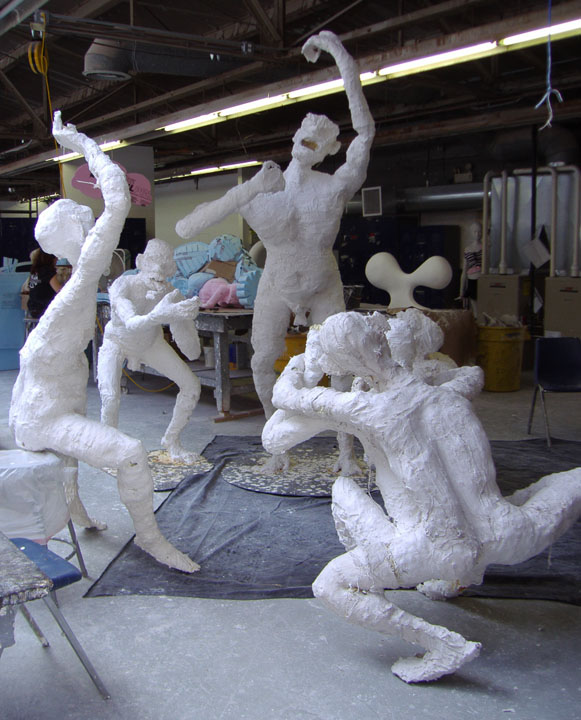
Perhaps it's the news that Floyd Landis is in trouble for "test[ing] positive...for illegally high levels of testosterone" that has me thinking of the studio visit we paid to Jon Fortmiller in the middle of Denise's Vandeville's weekly debauch. For those who've not been there, Jon is hard at work on a troop of plaster monkeys who are occupying themselves, as monkeys do, by flinging poo, masturbating furiously, and same-sex coupling. John basked in the enthusiastic support of his classmates for this work, which he regards as critical of frat boy behavior, and got an especially warm crit from alum Romi Schroeder-Falzone for depicting maleness with such conviction in a culture and art world where the female form is so ubiquitous as to be a trite, formal device rather than a body.
The humor and wisdom of Jon's displacement of human male carnality on to other primates notwithstanding, I think it's time to complicate this critique before the discourse on Guy-Art at UArts gets over-determined. From my perch among the faculty, this seems like the most exaggeratedly raunchy year I've seen since I got here four years ago. I've been in crits framed by S&M, seen the most articulately painted breasts the school has had on view in perhaps decades (painted by both male and female painters, and generally played witness to what has been a more playful and frank atmosphere than we've had around here in a few years. Who threw open the windows?
But guy-ness appears to be everywhere all the sudden - here's what Roberta Smith observed in a piece in today's Times on summer shows in Chelsea:
Chelsea’s group-show summer fray can evoke a farmyard with a surplus of roosters. This was especially the case last summer when male artists and curators seemed to dominate, along with a plethora of Conceptually-based black-on-black appropriation art. At the time the term “boys in black” came to mind, and to a certain extent they’re back.
But it should be remembered that gender is a nuanced thing, not a start division. Lest we fall in to the mirror trap of objectification, perhaps we ought to think twice before getting serious about a formula that reads something like male=sexual=aggressive=primitive. What is lust and who gets to express it openly? What's the meeting ground between the intellectual discourse of gender and rather-more-difficult-to intellectualize arena of sex? (An amusing photo-essay on maculinity can be found at a blog by Graham Milton.) As tired as people might be of the sensitive metrosexual male, essentializing masculinity as restrictively as femininity has been circumscribed isn't necessarily the solution.
Saturday, July 15, 2006
Newsletter Pitches
Criticism students - these are the ideas that came over the transom for the newsletter. I've put a few remarks in after each one to help shape the piece, but we will be talking about these and discussing progress on July 19 with me and on July 21 with James Rosenthal. At the end of the list, I've put in some things that no one pitched that are worth considering, so let me know if youy want to change tracks.
Melinda Steffy - "I'm writing a feature on the Bike Parts show at Nexus, a fund-raising auction for a non-profit bike organization, especially considering the dynamics of a non-art organization using 'outsider' art to raise money."
Denise Vandeville - need written pitch!
Aubrey Navarro - need written pitch!
Paul DeMarco - 1. 600 words: Review of Charles Long’s recent ICA exhibit Gone Formalism in the context of his recent UARTS lecture using a completely arbitrary set of standards and condition.
2. Table and 400 words: A brief review of Philadelphia area MFA programs based solely on the available promotional materials. Areas of interest will include: program focus, demographic, goals/mission, accessibility, etc.
Jason Pemberton - need written pitch!
Fred Holcomb - "I plan to write one 1200 word newsletter article on the current “grid” show at Gallery Joe. The use of the grid can be both bold and mundane. But after a half century of minimalism, what more needs to be said of it.? The show is not a historical review. Having recently read Rosiland Krauss’s comments on the grid in her 1981 “The Originality of the Avant-Garde…,” I am particularly interested in this exhibit. After the class discussion yesterday, I agree to shorten the "grid" review and add another gallery review. I mentioned the Black Mountain show in class but am now leaning toward the William T. Wiley show at Locks, but haven't seen it yet."
Mike Reenock - "I intend to write a descriptive piece about Philadelphia painter Robert Goodman’s studio. This piece will be focus primarily on the physical aspects of Goodman’'s studio and its role as something other than merely a “place to paint.”"
Chris Houston - I plan to review the current show, Dialogues: A Group Exhibition at the Sande Webster Gallery, 2006 Walnut St., July 5th though August 23rd. The show opening is Friday July 14th.
Vanessa Juriga - Is writing about Woodmere Art Museum's members' exhibit. need written pitch!
Walter Plotnick - I plan write 6 short reviews, mainly focused on art in the Philadelphia Northern Suburbs. Four of which will be reviews of work that are presently on display at various galleries. Two will be studio visits, seek peeks of new work....behind the scenes of established artists who happen to live in the Northern Suburbs of Philadelphia. First, Anthony Lent, Senior Professor at F.I.T in NYC. Second Jon Clark, Professor & Chair of the Glass Dept. at Tyler School of Art.
Jared Udell - "The article will be a converstation with artist Adam Parker Smith. Adam recieved his MFA at Tyler and has been showing and teaching throughout Philadelphia. He is another painter gone hybrid, who creates soft sculpture which are shown along with his drawings and a paintings. Adam is represented by Peng Gallery. This past month he has made the move to NYC. I will discuss his time in Philadelphia and his decison to move to New York.
I see parallels in our goals and I am interested in this for my own experience, and to hear about the pros and cons of both art worlds; NYC and Philly."
Terri Saulin - "I would like to write a piece discussing the chasm between fine art and craft. Specifically, ceramic art and sculpture. I plan to interview Jeff Guido from the Clay Studio, either Ken Vavrek or Jack Thompson, perhaps Paula Winokour during my critique this wed. I am also interested in a poetic reading of the Louise Bougeois show at The Fabric Workshop."
Other things to think about: Louise Bourgeois @ Fabric Workshop/Lonnie Graham @ Fabric Workshop/ Zoe Strauss July 19 slide show/ Stories based on access to visiting artists (Ellen Harvey!)
Melinda Steffy - "I'm writing a feature on the Bike Parts show at Nexus, a fund-raising auction for a non-profit bike organization, especially considering the dynamics of a non-art organization using 'outsider' art to raise money."
gerard suggests - the big question here may be about the social usefulness of art, and in some ways the story is in line with the debate between Croce and Oates. Do such things diminish or help art? Another example might be the vogue for using art to address issues of violence, as in Goods for Guns
Denise Vandeville - need written pitch!
Aubrey Navarro - need written pitch!
Paul DeMarco - 1. 600 words: Review of Charles Long’s recent ICA exhibit Gone Formalism in the context of his recent UARTS lecture using a completely arbitrary set of standards and condition.
gerard says: Good. Go for it.
2. Table and 400 words: A brief review of Philadelphia area MFA programs based solely on the available promotional materials. Areas of interest will include: program focus, demographic, goals/mission, accessibility, etc.
gerard says: This is good – I assume the schools are Arts, Tyler, Penn and PAFA. The sooner you can specify four-to-six criteria the better, because then the designer can ration out the space for the table.
Jason Pemberton - need written pitch!
Fred Holcomb - "I plan to write one 1200 word newsletter article on the current “grid” show at Gallery Joe. The use of the grid can be both bold and mundane. But after a half century of minimalism, what more needs to be said of it.? The show is not a historical review. Having recently read Rosiland Krauss’s comments on the grid in her 1981 “The Originality of the Avant-Garde…,” I am particularly interested in this exhibit. After the class discussion yesterday, I agree to shorten the "grid" review and add another gallery review. I mentioned the Black Mountain show in class but am now leaning toward the William T. Wiley show at Locks, but haven't seen it yet."
gerard suggests - the histoircally conscious approach to the Gallery Joe show sounds good, and it can probably be addressed n less than 750 words. If you drop the Black Mountain show, some one else should pick it up, but I would encourage you to choose between the Locks and Mayer shows based on your interest in the work.
Mike Reenock - "I intend to write a descriptive piece about Philadelphia painter Robert Goodman’s studio. This piece will be focus primarily on the physical aspects of Goodman’'s studio and its role as something other than merely a “place to paint.”"
gerard suggests:This sounds like a good feature, it's a profile, but it's not. Perhaps we can run it under a department heading like "studio view". The folks in publicaitons who are designing our newsletter said photos are good, and I'll give you the specs. The one caution I have is that you go with an open mind. It's possible that the studiois just a place to paint for some artists: always try to approach your writing as an open question that can be proven or disproven through research.
Chris Houston - I plan to review the current show, Dialogues: A Group Exhibition at the Sande Webster Gallery, 2006 Walnut St., July 5th though August 23rd. The show opening is Friday July 14th.
gerard suggests: it would be good to articulate hte angle of this piece as soon as possible. Is it reportage (this happened, I saw it)? Or in some way critical?
Vanessa Juriga - Is writing about Woodmere Art Museum's members' exhibit. need written pitch!
Walter Plotnick - I plan write 6 short reviews, mainly focused on art in the Philadelphia Northern Suburbs. Four of which will be reviews of work that are presently on display at various galleries. Two will be studio visits, seek peeks of new work....behind the scenes of established artists who happen to live in the Northern Suburbs of Philadelphia. First, Anthony Lent, Senior Professor at F.I.T in NYC. Second Jon Clark, Professor & Chair of the Glass Dept. at Tyler School of Art.
Jared Udell - "The article will be a converstation with artist Adam Parker Smith. Adam recieved his MFA at Tyler and has been showing and teaching throughout Philadelphia. He is another painter gone hybrid, who creates soft sculpture which are shown along with his drawings and a paintings. Adam is represented by Peng Gallery. This past month he has made the move to NYC. I will discuss his time in Philadelphia and his decison to move to New York.
I see parallels in our goals and I am interested in this for my own experience, and to hear about the pros and cons of both art worlds; NYC and Philly."
gerard replies: We've already talked about this not being so much an interview or profile as a piece in which the phenomenon of the artist who migrates to NY is addressed through the example. Because this is the point of the article, I think you should back off the description of his work and focus on his decision to move, the contributing factors that influenced it, and what it's lead to so far.
Terri Saulin - "I would like to write a piece discussing the chasm between fine art and craft. Specifically, ceramic art and sculpture. I plan to interview Jeff Guido from the Clay Studio, either Ken Vavrek or Jack Thompson, perhaps Paula Winokour during my critique this wed. I am also interested in a poetic reading of the Louise Bougeois show at The Fabric Workshop."
gerard replies: This is very, very good. Jeff is a good source, and Paula would be great. I would remember that a good argument is usually built on three points, and choose your interview subjects carefully to express those ideas. I assume we're talking about two things - an essay on craft (a feature? 600-800wds?) and a poetic review of Louise Bourgois (200-400wds.)?
Other things to think about: Louise Bourgeois @ Fabric Workshop/Lonnie Graham @ Fabric Workshop/ Zoe Strauss July 19 slide show/ Stories based on access to visiting artists (Ellen Harvey!)
Thursday, July 06, 2006
Under the Influence
Tonight is the first of our film screenings. and I've been interested in addressing the question of influence for some time now. It seems that now is time.
The Oxford American Dictionary, in defining influence, offers the following word history:
The operative word in the definition since the 16th century seems to be imperceptible or indirect, that the influence of one thing on another is observed by a third party, more than recognized by the changed subject. Somehow or another, that connotation of mysterious or imperceptible action still resides in the word, which perhaps explains why it feels so much like someone is dragging his finger nails across a blackboard when he names his “influences” in a critique or statement.
Influence is, I assert, being too narrowly understood and converted to a neutral, almost clinical term in such instances. When citing their influences, artists often sound more like bibliographers than introspective critics of their practice. In almost all cases, it would be more apt to say “I admire so and so’s work…” or “I have tried to steal this or that property of so and so’s paintings…” (a valuable attempt to re-think this problem came from Keith Gruber in his March 10 post on this blog.) Using the word influence generally allows the artist to behave like an infected person, one who cannot take responsibility for the reference to other art or ideas in his or her work (the word, influenza actually entered the English language from Italian in the mid 1700's by way of the root that influentia, a medieval forerunner of influence).
But artworks are not sneezes, scabs, or otherwise to be confused with the results of infection. They are, if anything, discursive objects and most of them are made with the intent to act in this capacity (those that are not made to do this but instead are selected from all the other objects in the word to function like this are called “found objects”…but that’s another essay). Disregarding the responsibility to intent diminished the force of a work. This doesn’t mean unconscious or spontaneous allusions are impermissible, it means that they should be rigorously and thoroughly understood by the artist as soon as they are identified so their power can be harnessed and directed where the artist wants to employ it.
I’m especially keen to hear form the artists who responded to the call for participation – Jane Irosh, Joe Nanashe, Isaac Resnikoff and Paul Falzone - because they have been thoughtful and deliberate in our correspondence and have indulged me by trying to understand how talking about movies might be a roundabout way of talking about their work.
It doesn’t seem that we’re going to get over the essentially pathological discourse of art practice that dominates contemporary art any time (more obsessive drawings, anyone?) but perhaps we start to be more specific about our relation to the world around us, what enters our making processes through which doors, and how it is greeted.
The Oxford American Dictionary, in defining influence, offers the following word history:
ORIGIN late Middle English : from Old French, or from medieval Latin influential| ‘inflow,’ from Latin influere, from in- ‘into’ + fluere ‘to flow.’ The word originally had the general sense [an influx, flowing matter,] also specifically (in astrology) [the flowing in of ethereal fluid (affecting human destiny).] The sense [imperceptible or indirect action exerted to cause changes] was established in Scholastic Latin by the 13th cent., but not recorded in English until the late 16th cent.
The operative word in the definition since the 16th century seems to be imperceptible or indirect, that the influence of one thing on another is observed by a third party, more than recognized by the changed subject. Somehow or another, that connotation of mysterious or imperceptible action still resides in the word, which perhaps explains why it feels so much like someone is dragging his finger nails across a blackboard when he names his “influences” in a critique or statement.
Influence is, I assert, being too narrowly understood and converted to a neutral, almost clinical term in such instances. When citing their influences, artists often sound more like bibliographers than introspective critics of their practice. In almost all cases, it would be more apt to say “I admire so and so’s work…” or “I have tried to steal this or that property of so and so’s paintings…” (a valuable attempt to re-think this problem came from Keith Gruber in his March 10 post on this blog.) Using the word influence generally allows the artist to behave like an infected person, one who cannot take responsibility for the reference to other art or ideas in his or her work (the word, influenza actually entered the English language from Italian in the mid 1700's by way of the root that influentia, a medieval forerunner of influence).
But artworks are not sneezes, scabs, or otherwise to be confused with the results of infection. They are, if anything, discursive objects and most of them are made with the intent to act in this capacity (those that are not made to do this but instead are selected from all the other objects in the word to function like this are called “found objects”…but that’s another essay). Disregarding the responsibility to intent diminished the force of a work. This doesn’t mean unconscious or spontaneous allusions are impermissible, it means that they should be rigorously and thoroughly understood by the artist as soon as they are identified so their power can be harnessed and directed where the artist wants to employ it.
I’m especially keen to hear form the artists who responded to the call for participation – Jane Irosh, Joe Nanashe, Isaac Resnikoff and Paul Falzone - because they have been thoughtful and deliberate in our correspondence and have indulged me by trying to understand how talking about movies might be a roundabout way of talking about their work.
It doesn’t seem that we’re going to get over the essentially pathological discourse of art practice that dominates contemporary art any time (more obsessive drawings, anyone?) but perhaps we start to be more specific about our relation to the world around us, what enters our making processes through which doors, and how it is greeted.
Subscribe to:
Posts (Atom)